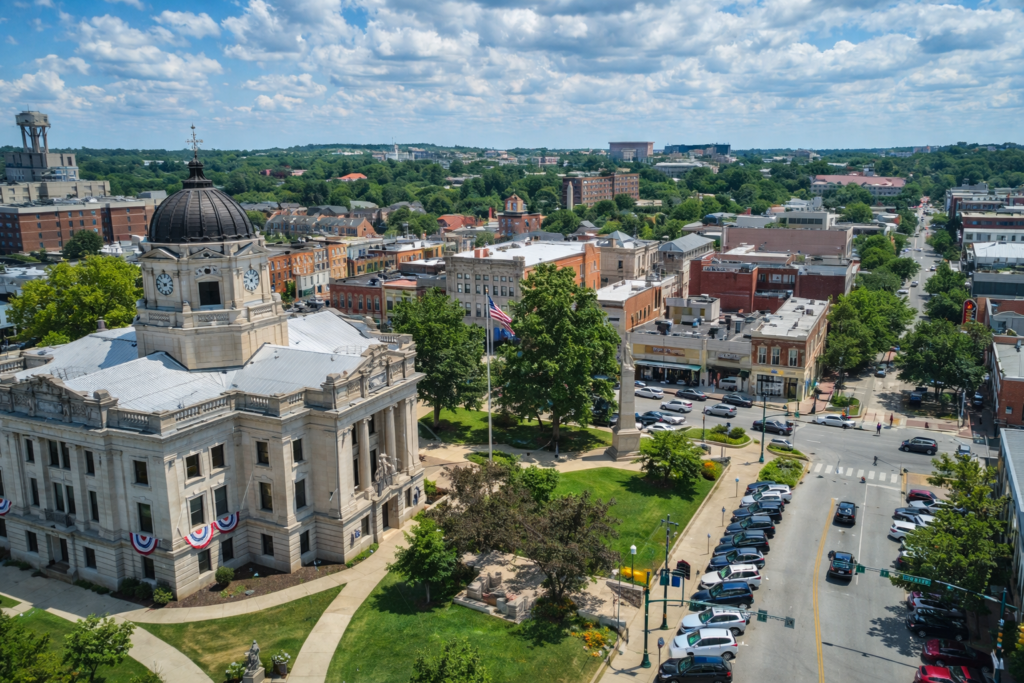
Bloomington Indiana is not a typical Midwestern affordability story nor is it a fast growing metro with endless opportunity. In real life this city functions as a college anchored economy with limited external industry which shapes everything from rent pricing to job availability. People who already have stable income streams university employees dual-income families or remote workers usually settle in more comfortably.
Those who rely on local private sector growth fast promotions or broad job mobility tend to feel constrained over time. Living in Bloomington Indiana is less about chasing growth and more about maintaining balance within a narrow economic structure. The city rewards predictability and penalizes instability. That reality matters more here than lifestyle preferences.
Read Also : Sugar Land Texas: The Ultimate Relocation, Financial Survival & Settlement Guide(2026)
Bloomington Indiana: The Economic Backbone.
Bloomington’s economy is highly concentrated with education and healthcare dominating employment. Indiana University is the central employer, directly and indirectly driving housing demand retail spending, and service jobs. Healthcare systems public education and university adjacent research roles fill most of the remaining stable positions. Outside of these the private sector is shallow mostly small businesses hospitality food services, and limited tech or professional services.
This concentration creates stability but also risk. When one institution anchors the economy, wage ceilings become rigid and job transitions stay limited. There are few large corporate offices and almost no diversified industrial base. For residents, this means consistent but slow income growth and for newcomers it means job availability depends heavily on timing and institutional hiring cycles. Economic resilience here comes from continuity, not expansion.
Read Also : Cary North Carolina – Living Cost, Jobs, Apartments, Student Housing & Real Survival Guide (2026)
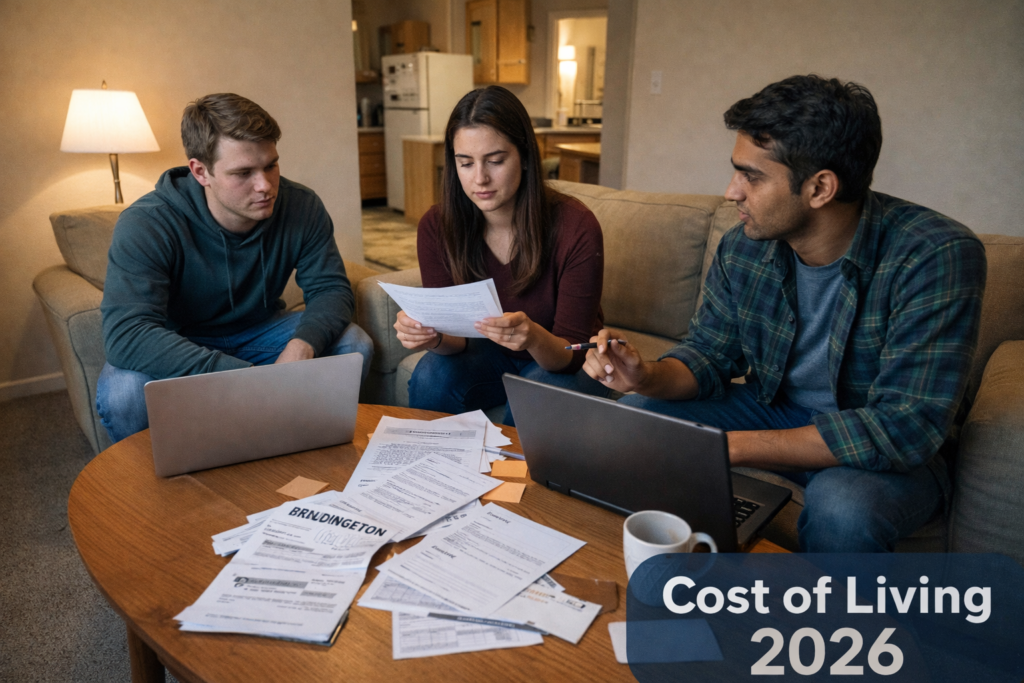
Bloomington Indiana: Cost of Living Explained With Logic
The cost of living in Bloomington Indiana sits above the Indiana average but below major Midwest metros. Housing is the primary driver of cost pressure not utilities or transportation. Rent is inflated by constant student demand which keeps vacancy rates low year round. Utilities remain moderate due to state pricing but older housing stock can push winter heating costs higher than expected.
Groceries cost slightly more than nearby towns because supply chains cater to a smaller market, while dining out skews expensive relative to local wages due to university-driven demand. Transportation costs stay manageable especially for residents living near employment hubs.
Families and students experience costs very differently. Students absorb higher per-bedroom rent but save on transportation and childcare. Families face rising housing costs without corresponding salary growth unless tied to institutional roles.

Estimated Monthly Costs (2026)
| Category | Single / Student | Family of 4 |
|---|---|---|
| Rent (City Center) | $1,100 – $1,400 | $2,100 – $2,800 |
| Rent (Outside Center) | $900 – $1,150 | $1,800 – $2,300 |
| Utilities (Heat, Elec, Water) | $180 – $250 | $320 – $450 |
| Groceries | $300 – $400 | $900 – $1,100 |
| Internet / Phone | $100 – $120 | $120 – $140 |
| Monthly Total (Excl. Rent) | $580 – $770 | $1,340 – $1,690 |
Costs behave this way because demand is predictable and supply growth is slow especially for family-sized housing.
Bloomington Indiana: Housing & Apartment Market Reality
The housing market in Bloomington is demand-driven not income-driven. Rental prices follow the academic calendar more than broader economic trends. Campus-adjacent apartments command premium pricing regardless of unit quality while non-campus neighborhoods offer better value but limited availability.
Seasonal pressure peaks between May and August, when leases reset for the academic year. This timing compresses choice and pushes renters into quick decisions. Family-sized rentals are scarcer than student units which creates upward pressure on single family home rents. Buying property is possible, but inventory remains tight and prices do not always reflect local wage levels.
Housing stability favors long-term residents who renew leases or own homes. Newcomers face the steepest entry costs.
Read Also : Overland Park Kansas – Complete Guide to Living, Jobs, Cost of Living & Lifestyle
Bloomington Indiana: Job Market & Income Reality
Bloomington’s job market is stable but narrow. Hiring is strongest in education healthcare administration and support services. Professional roles outside the university system marketing finance software operations exist but are limited in volume and growth potential. Manufacturing and logistics opportunities are minimal.
Average household incomes sit in a range that covers basic living costs but leaves little margin for rapid advancement. Wage growth is slower than inflation during tight housing cycles. Many residents maintain financial balance through dual incomes or remote employment tied to higher-paying regions.
For job relocators, moving to Bloomington Indiana without secured employment carries risk. The market rewards specialization and existing credentials but offers limited flexibility for career pivots.

Bloomington, Indiana: Daily Living Reality
Daily life in Bloomington leans toward planned routines rather than convenience-driven sprawl. Public transportation works reasonably well for students and campus workers but becomes less practical for families living farther out. Car ownership increases mobility and reduces time costs.
Weather impacts expenses more than expected. Cold winters raise heating bills while seasonal maintenance costs add up for homeowners. Grocery shopping remains practical but eating out frequently strains budgets due to pricing relative to wages. Residents who cook at home consistently experience lower cost pressure.
Life here feels predictable efficient if your needs align, restrictive if they do not.

Read Also : Orem, Utah Cost of Living, Jobs & Housing (2026): Is It Worth Moving?
Bloomington Indiana: Life Experience by Profile
Students :
Students find structured affordability through shared housing and walkable access. Costs are manageable when aligned with academic schedules but private studios and short-term leases are expensive.
Families:
Families benefit from stability and services but face housing competition and limited salary acceleration. Financial comfort depends heavily on secure employment.
Immigrants:
Immigrants often integrate through university or healthcare roles. Outside those channels, job options narrow quickly, making income continuity essential.
Remote Workers:
Remote workers experience Bloomington as financially efficient with moderate costs and fewer lifestyle expenses, provided housing is secured early.
Each profile interacts differently with the same economic constraints.
Bloomington, Indiana: Is This City Worth Living In?
Is Bloomington Indiana a good place to live in 2026? The answer depends on income predictability and job alignment. For households tied to education healthcare or remote work the city offers stability and manageable living costs. For those seeking rapid career growth, diversified industries or frequent job mobility limitations appear quickly. Bloomington rewards consistency more than ambition. It works best for residents who value predictability over expansion and who enter with realistic expectations about wages, housing, and opportunity ceilings.
Read Also : Moving to Naperville Illinois? Your Complete Guide to Cost of Living Jobs & Best Hotels
FAQs
Is Bloomington Indiana a good place to live in 2026?
Yes, for residents with stable or institutional income. Growth-driven professionals may find it limiting.
What is the cost of living in Bloomington Indiana?
Higher than most Indiana cities driven mainly by housing and student demand.
Is Bloomington Indiana expensive for families?
Housing costs strain single-income families. Dual incomes improve affordability.
How is the job market in Bloomington Indiana?
Stable but narrow, centered on education, healthcare, and services.
Is Bloomington Indiana good for students?
Yes. Housing access and transportation favor student lifestyles.
Is Bloomington Indiana safe to live in?
Generally safe with typical small city concerns rather than high-crime patterns.
Do you need a car in Bloomington Indiana?
Students can manage without one; families usually benefit from owning a car.
Is Bloomington Indiana worth moving to?
Worth it for stability-focused households less ideal for aggressive career movers.