Your Complete 2026 Guide for Movers, Job Seekers & First-Time Tourists
Atlanta is not just a city it is an experience that hits you differently the moment you land at Hartsfield-Jackson the world’s busiest airport. Whether you are seriously considering living in Atlanta Georgia, chasing a high-paying career opportunity, or planning your very first visit to the American South, this guide covers everything you need to know the good, the surprising, and the things most travel articles conveniently skip.
From the cost of living in Atlanta to the best neighborhoods, job market salaries, visa rules for foreigners, top restaurants, healthcare, insurance, and practical survival tips this is the only Atlanta Georgia guide you will need in 2026. It is written for US citizens thinking of relocating, for international professionals planning a move, and for tourists visiting for the first time who want an honest, complete picture before they arrive.
What Makes Atlanta Georgia So Addictive City Overview
Atlanta is the capital and largest city of Georgia, tucked into the foothills of the Appalachian Mountains at an elevation of 1,050 feet above sea level — making it one of the highest major cities in the eastern United States. The metro area is home to nearly 6.3 million people, making it the ninth-largest metropolitan area in the country. The city is famously diverse, with approximately 51% of residents identifying as Black or African American a fact that has earned Atlanta the unofficial title of the “Black Mecca” of the South.
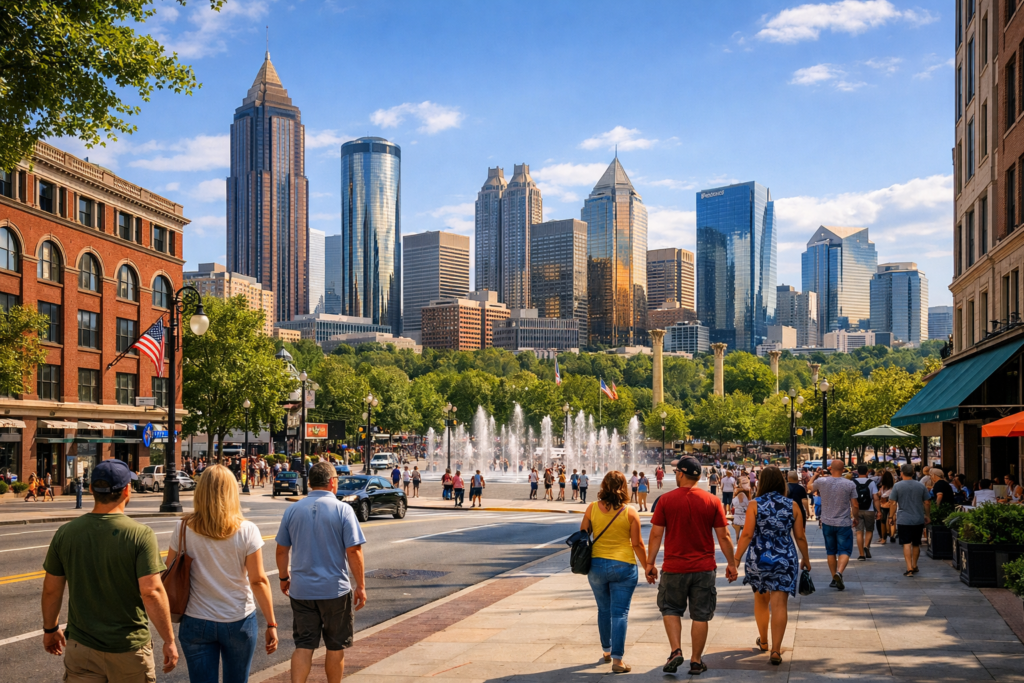
The city’s economy is anchored by genuine global giants. Coca-Cola, Delta Air Lines, CNN, UPS, Home Depot, and Chick-fil-A all call Atlanta home. The tech sector has grown explosively, with Google, Microsoft, and hundreds of startups establishing major operations here. Atlanta is also the Hollywood of the South more film and television productions are shot in Georgia than almost anywhere else in the world, driven by the state’s generous 30% tax credit for productions. Tyler Perry Studios, one of the largest studio lots in America, operates right in the city.
Surprising fact: Atlanta has more trees per square mile than almost any other major American city. Over 47% of the city is covered by tree canopy — earning it the enduring nickname “City in a Forest.” Visitors often remark how green and leafy the city feels compared to other major metros.
Read Also :New York City Cost of Living 2026: Survival Guide for Families & Immigrants
Atlanta Georgia Weather A Season-by-Season Guide for Visitors and New Residents
Atlanta enjoys a humid subtropical climate with four genuine seasons. Here is what each season actually looks and feels like:
- Spring (March–May): The most beautiful time to visit. Temperatures range from 55°F to 75°F (13°C–24°C). Cherry blossoms and dogwoods bloom across the city. Pack light layers and a compact rain jacket.
- Summer (June–August): Hot and legitimately humid. Expect 88°F–95°F (31°C–35°C). Light, breathable clothing is non-negotiable. Afternoon thunderstorms are a near-daily occurrence in July and August.
- Fall (September–November): Many locals consider this the finest season. Temperatures settle at 60°F–75°F (15°C–24°C). Fall foliage across Piedmont Park and Stone Mountain is genuinely stunning.
- Winter (December–February): Mild and manageable, averaging 35°F–55°F (2°C–13°C). Snow is rare — but ice storms happen and the city shuts down fast when they do.
Best months for tourists: March through May and September through November offer the most pleasant conditions for sightseeing and outdoor activities.
Weather myth to bust: Many people assume Atlanta is warm and sunny year-round. The reality is Atlanta receives approximately 50 inches of rain per year more annual rainfall than Seattle, Washington. Always carry an umbrella.
Living in Atlanta Georgia: The Real Cost of Living Nobody Honestly Breaks Down
Atlanta is considerably more affordable than New York, Los Angeles, or San Francisco, but it is not cheap by national standards. The overall cost of living in Atlanta sits roughly 15–20% above the US national average. The critical difference is that salaries in Atlanta are also above average — meaning your purchasing power can be genuinely strong if you are employed in a professional field.

| Expense | Atlanta, Georgia | US National Average |
|---|---|---|
| 1BR Rent (City Centre) | $1,953/mo | $1,500/mo |
| Meal at Restaurant | $25 | $15 |
| Monthly Transport Pass | $95 | $70 |
| Utilities Monthly | $191 | $180 |
| Average Monthly Salary (After Tax) | $5,160/mo | $3,500/mo |
| Gym Membership | $36/mo | $40/mo |
| Cinema Ticket | $17 | $13 |
| McDonald’s Combo Meal | $12 | $10 |
| Mobile Phone Plan (10GB+) | $67/mo | $50/mo |
A one-bedroom apartment in the city centre will cost approximately $1,953 per month, while outside the centre prices drop to around $1,497 per month. A three-bedroom apartment in the city centre averages $3,447 per month.
Groceries are reasonably priced: a dozen large eggs costs $4.30, a kilogram of chicken is $13.71, and a loaf of bread runs about $3.99. Gasoline is among the cheapest in the nation at $0.78 per liter. Your monthly mobile phone plan will run approximately $67 for a solid 10GB+ data package.
The most important number: The average monthly net salary after tax in Atlanta is $5,160 well above the US national average of $3,500. If you secure a professional position, you can genuinely save money here in a way that is simply not possible in cities like San Francisco or New York.
Read Also : How Much Does It Cost to Live in Fayetteville Arkansas in 2026? Full Breakdown
Best Neighborhoods in Atlanta Georgia Where Should You Actually Live?
Choosing the right neighborhood in Atlanta is one of the most important decisions you will make. Each area has a distinct personality, price range, and lifestyle.
| Neighborhood | Best For | Safety | Avg Rent/Month |
|---|---|---|---|
| Buckhead | Luxury families | Very Safe | $3,200+ |
| Midtown | Young professionals | Safe | $2,400 |
| Old Fourth Ward | Artists & creatives | Moderate | $2,100 |
| Downtown Atlanta | Professionals | Use caution | $1,950 |
| College Park | Budget living | Research needed | $1,400 |
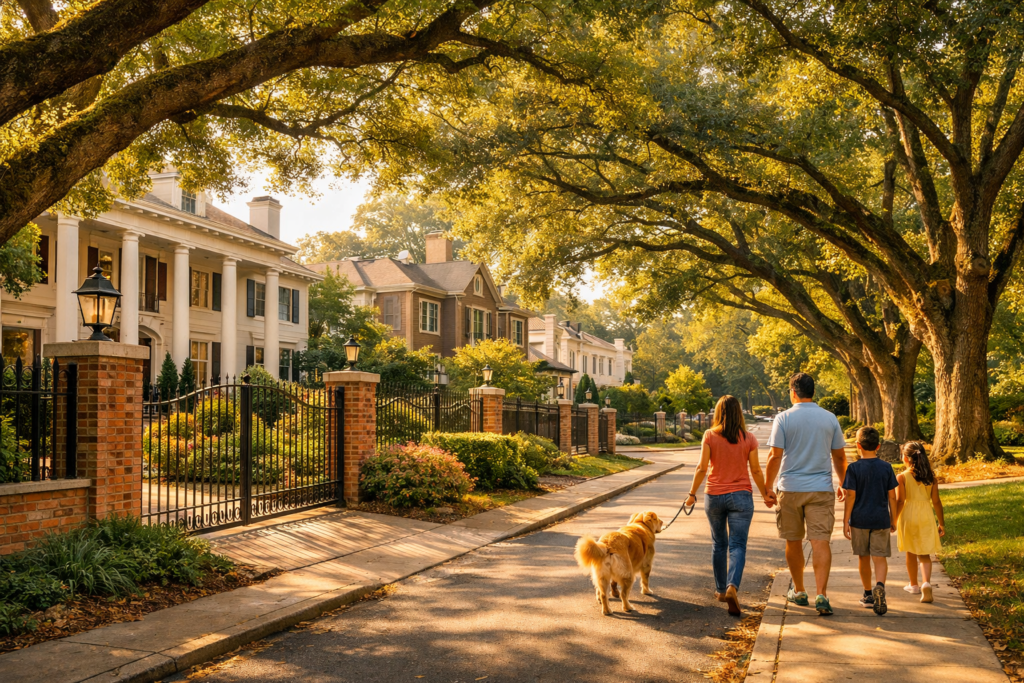
For families: Buckhead is the gold standard excellent private schools, manicured residential streets, and a suburban feel with city-level conveniences. Sandy Springs and Dunwoody are equally strong choices for families prioritizing quality public schools and safety.
For young professionals: Midtown is where the energy concentrates. Walkable, dense, close to tech employers and Piedmont Park. Old Fourth Ward has exploded in popularity due to the Atlanta BeltLine trail running directly through it.
For budget living: College Park, East Point, and Decatur offer rents significantly below the city average. Clarkston often described as the most ethnically diverse square mile in America — is a hidden gem for newcomers seeking affordable rent alongside a genuinely international community.
Areas requiring research: Parts of southwest Atlanta and certain streets near the airport have elevated crime rates. Always research the specific block, not just the neighborhood name.
Is Atlanta Georgia Safe? Honest Crime Data Every Newcomer and Tourist Must Read
To be straightforward: Atlanta’s overall crime index is higher than the US national average, and violent crime is a genuine concern in specific parts of the city. That said, context is essential.
The safest areas for living and visiting include Buckhead, Midtown, Sandy Springs, Dunwoody, Decatur, and Brookhaven. These neighborhoods are genuinely safe for families, solo travelers, and new arrivals. Millions of tourists visit Atlanta every year without incident.
Safety tips for tourists and new residents:
Safety tips for tourists and new residents:
- Avoid walking alone in unfamiliar neighborhoods after midnight
- Use Uber or Lyft at night rather than walking long distances
- Never leave valuables visible in a parked car — vehicle break-ins are common
- Download the SpotCrime app or check the Atlanta Police Department crime map before committing to a specific address
- For foreigners: tourist zones, Midtown, and Buckhead are safe and welcoming — Atlanta is a cosmopolitan, internationally oriented city
Jobs in Atlanta Georgia — Salaries, Industries, and Who Is Actively Hiring
The job market in Atlanta Georgia ranks among the strongest in the entire southeastern United States. The average monthly net salary after tax is $5,160 — considerably above the national average.
| Industry | Average Salary | Top Companies |
|---|---|---|
| Technology | $85,000 – $160,000 | NCR, Cox, Microsoft, Google |
| Healthcare | $55,000 – $120,000 | Emory, Piedmont, CDC, WellStar |
| Finance & Banking | $60,000 – $130,000 | Delta, Equifax, SunTrust |
| Entertainment / Media | $50,000 – $110,000 | CNN, Tyler Perry Studios |
| Hospitality | $35,000 – $55,000 | Marriott, Hilton, Hyatt |
| Logistics & Supply Chain | $55,000 – $95,000 | UPS, Home Depot, Coca-Cola |
Atlanta is becoming a genuine technology hub. The “Silicon Peach” corridor concentrated in Alpharetta, Dunwoody, and Midtown houses dozens of technology companies ranging from established firms to fast-growing startups. Logistics and supply chain employment is a unique Atlanta strength, with Hartsfield-Jackson Airport and UPS’s global hub providing thousands of well-paid positions.
Top job portals: Indeed, LinkedIn, Dice (for tech roles), Handshake (for graduates), and the Georgia Department of Labor portal. Competition for top roles is real — polish your resume and build your LinkedIn network before you arrive.

Read Also : Living in Bloomington Indiana (2026): Cost ,Jobs, Apartments & Salary Reality
Visa and Work Permit Guide for Foreigners Moving to Atlanta Georgia
Atlanta’s metropolitan area hosts one of the fastest-growing and most diverse immigrant populations in the United States. Here is what foreign nationals need to understand about working legally:
- H-1B Visa: For skilled workers in tech, engineering, finance, and medicine. Employer must sponsor. Annual cap: 85,000 visas. Processing: 3–6 months standard, 15 business days with premium processing ($2,805).
- OPT (Optional Practical Training): Work for 12–36 months post-graduation from a US university without a separate work visa. STEM graduates receive the full 36-month extension.
- EB-2 / EB-3 Green Card: Employment-based permanent residency. Expect 5–10+ years for applicants from India and China due to country backlogs.
- TN Visa: For Canadian and Mexican nationals under USMCA. Covers many professional categories and is considerably faster than H-1B.
Atlanta’s immigrant communities are large and supportive. The South Asian community concentrates in Alpharetta, Duluth, Johns Creek, and Suwanee — Atlanta’s “Silicon Peach.” A thriving Korean community is anchored in Doraville, and a large Vietnamese community is concentrated along Buford Highway.
Practical tip: Join Facebook groups like “Indians in Atlanta” or “Desis in ATL” and the Reddit community r/Atlanta for honest, real-world relocation advice.
Getting Around Atlanta Georgia The Honest Truth About MARTA and Why You Need a Car
There is no diplomatic way to say this: Atlanta is a car-dependent city. If you are planning on living in Atlanta Georgia long-term, you will need a car for most of your daily life.
MARTA operates four rail lines connecting the airport to Downtown, Midtown, Buckhead, and Decatur. A monthly pass costs $95. For tourists staying in core areas, MARTA is genuinely useful and affordable.
- Single MARTA ride: $2.50
- Uber/Lyft average ride within the city: $15–$30
- Car rental for tourists: $50–$80 per day
- Gasoline: $0.78 per liter — among the lowest in the US
- Downtown parking: $15–$30 per day
Traffic warning: I-285 (the Perimeter) and the I-75/I-85 Downtown Connector are among the most congested highways in America. Avoid both between 7–9 AM and 4–7 PM. Google Maps and Waze are essential daily tools. The Atlanta BeltLine — a 22-mile multi-use trail connecting 45 neighborhoods — is perfect for cycling and walking short urban distances.
Read Also : Is Bloomington, Indiana Worth Living In? Cost of Living, Jobs & Housing Reality (2026)
Best Hotels in Atlanta Georgia — From Budget Stays to Memorable Luxury Experiences
Whether you are a first-time tourist or a professional arriving for a relocation, Atlanta offers accommodation to match every requirement and budget. Best base areas: Midtown, Buckhead, and Downtown.
| Hotel | Rating | Price/Night | Category | Book On |
|---|---|---|---|---|
| The Candler Hotel Atlanta | 4.8/5 | from $229 | Luxury | Booking.com |
| Hotel Clermont | 4.6/5 | from $189 | Boutique | Expedia |
| Omni Atlanta Hotel | 4.5/5 | from $179 | Mid-range | Hotels.com |
| Glenn Hotel Autograph | 4.4/5 | from $159 | Mid-range | Marriott.com |
| Holiday Inn Express Midtown | 4.1/5 | from $110 | Budget | IHG.com |
Airbnb is widely available across Atlanta from approximately $70–$110 per night. Most popular Airbnb neighborhoods: Midtown, Old Fourth Ward, and Grant Park. For newcomers apartment hunting, Furnished Finder and corporate housing services offer better value for stays of one to three months.
Where to Eat in Atlanta Georgia — Southern BBQ, International Cuisine, and Hidden Gems
Atlanta’s food scene is genuinely world-class and consistently underrated. The city has produced some of America’s most acclaimed chefs, and the Southern food tradition embedded here is unlike anything you will taste anywhere else.
- Slutty Vegan (multiple locations): Plant-based burgers with a cult following. Oprah-endorsed. There is almost always a queue — and the wait is worth it.
- Mary Mac’s Tea Room: Atlanta’s oldest continuously operating restaurant since 1945. Fried chicken, collard greens, sweet tea, cornbread — a non-negotiable Atlanta experience.
- Ponce City Market Food Hall: Best single spot for sampling multiple cuisines under one roof, located in the beautifully restored Sears building directly on the BeltLine.
- Buford Highway Food Corridor: A ten-mile stretch of international restaurants — Vietnamese pho, Korean BBQ, Mexican tacos, Chinese dim sum, Ethiopian injera. This is where Atlanta’s immigrant communities eat — authentic, affordable, and extraordinary.
- The Optimist: James Beard Award-nominated seafood restaurant in West Midtown. Reserve well in advance.
- Chick-fil-A: An Atlanta institution — the chain was founded here and locals take it very seriously.
Budget dining tip: Buford Highway is the single best value dining experience in the city full meals from $8–$15. Ponce City Market is excellent for a quality lunch or dinner without an excessive bill.

Read Also : Moving to Naperville Illinois? Your Complete Guide to Cost of Living Jobs & Best Hotels
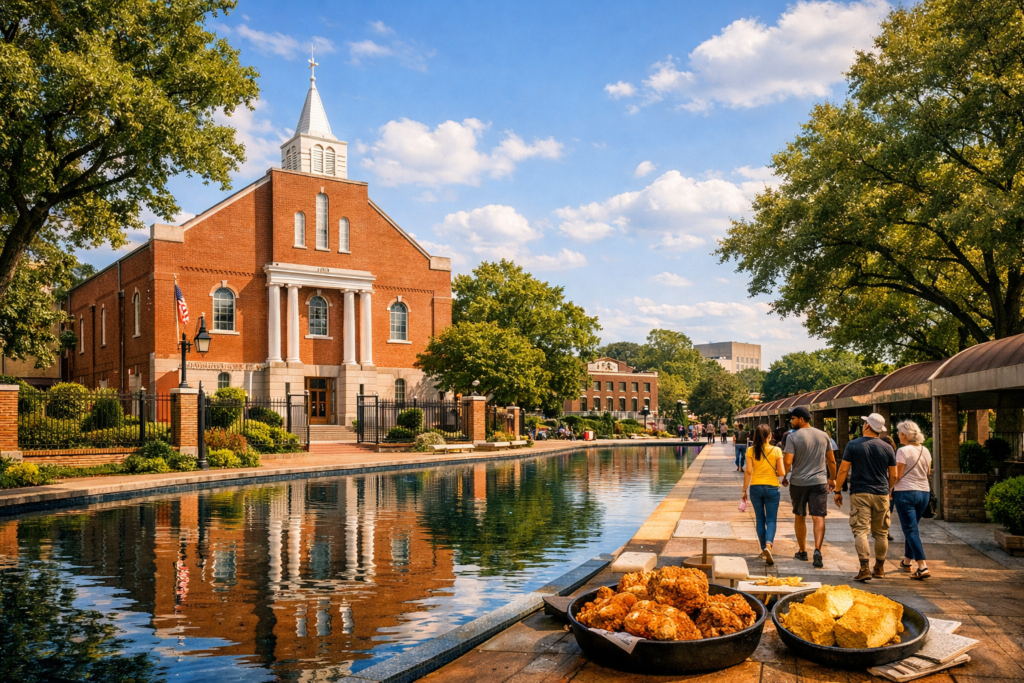
Top Attractions and Tours in Atlanta Georgia — What Every First-Time Visitor Must See
Atlanta consistently surprises visitors who arrive expecting a second-tier southern city and instead find a metropolis loaded with world-class museums, historic landmarks, and free public spaces.
| Attraction | Rating | Entry Fee | Best For |
|---|---|---|---|
| Martin Luther King Jr. Historic Site | 4.6/5 | FREE | History lovers |
| Georgia Aquarium | 4.7/5 | $45/adult | Families & tourists |
| Centennial Olympic Park | 4.2/5 | FREE | Everyone |
| Fox Theatre | 4.7/5 | Varies | Arts & culture |
| Atlanta History Center | 4.6/5 | $22/adult | History buffs |
| Piedmont Park | 4.6/5 | FREE | Outdoor lovers |
| World of Coca-Cola | 4.5/5 | $22/adult | First-time visitors |
The Georgia Aquarium is the largest aquarium in the Western Hemisphere. The Martin Luther King Jr. National Historic Site is one of the most significant historical sites in all of America — no visitor to Atlanta should skip it. Stone Mountain Park, 16 miles east of downtown, offers spectacular hiking and stunning Atlanta skyline views.
Shopping in Atlanta Georgia — Luxury Boutiques, Outdoor Malls, and Bargain Markets
Atlanta is a legitimate shopping destination. Lenox Square and Phipps Plaza in Buckhead represent the luxury tier — Gucci, Louis Vuitton, Tiffany & Co., and Nordstrom anchor both malls.
For a contemporary experience, Ponce City Market is the trendiest option — independent boutiques, artisan food vendors, a rooftop amusement park, and direct BeltLine access. Little Five Points is Atlanta’s answer to Brooklyn’s vintage scene: independent record stores, alternative boutiques, and bookshops fill this eclectic neighborhood. For budget and international shopping, the Buford Highway Farmers Market carries food items and goods from dozens of countries — a favourite for Atlanta’s immigrant communities.

Nightlife and Entertainment in Atlanta Georgia — The City That Invented Its Own Sound
Atlanta — the city that produced OutKast, Usher, and the entire trap music genre takes its entertainment infrastructure seriously.

- Buckhead: Upscale bars, rooftop lounges, and clubs along Peachtree Road. Smart casual dress code at most venues.
- Midtown: More relaxed and LGBTQ+ friendly. Excellent bars with outdoor seating around Piedmont Park.
- Little Five Points / East Atlanta Village: Alternative and live music scene. Great dive bars, local bands, younger crowd.
- State Farm Arena: Home of the Atlanta Hawks and premier concert venue in the Southeast.
- Happy Hour tip: Most Midtown and Buckhead bars run happy hour 4–7 PM with cocktails from $5–$8.
Healthcare and Hospitals in Atlanta Georgia — World-Class Medical Infrastructure
Atlanta possesses healthcare infrastructure that ranks among the best in the entire southeastern United States.
Top hospitals: Emory University Hospital (consistently nationally ranked), Piedmont Atlanta Hospital, WellStar Atlanta Medical Center, and Children’s Healthcare of Atlanta (CHOA) — one of the finest pediatric networks in the country.
The Centers for Disease Control and Prevention (CDC) is headquartered in Atlanta. The city is genuinely at the forefront of American public health. Emory’s Rollins School of Public Health is one of the top-ranked programs globally. For primary care, urgent care clinics (AFC Urgent Care, CityMD) are available city-wide with same-day walk-in service.

Read Also : Orem, Utah Cost of Living, Jobs & Housing (2026): Is It Worth Moving?
Health Insurance in Atlanta Georgia — Understanding the System Before It Overwhelms You
Health insurance in the United States operates unlike any system most foreigners have encountered before. If you are employed full-time, your employer will offer a group health insurance plan — this is by far the most affordable route. Employer-sponsored plans typically cover 60–80% of monthly premiums, meaning your personal cost might be $150–$400 per month for solid individual coverage.
If you are self-employed or between positions, purchase coverage through the Georgia Health Insurance Marketplace (healthcare.gov). Individual plan premiums range from approximately $300–$600+ per month depending on coverage tier and income level.
For foreigners on H-1B visas, employer-sponsored insurance is the standard path. International students on F-1 visas can access their university’s student health insurance plan at subsidized rates.
Critical warning: Never go uninsured in the United States. A single emergency room visit without insurance can generate a bill of $5,000–$30,000 with no caps on what providers may charge.
Buying a Home in Atlanta Georgia Mortgage Rates, Property Prices, and What Buyers Must Know
Atlanta’s residential property market has appreciated significantly over the past decade, yet remains far more accessible than coastal metros. The current average mortgage interest rate for a 20-year fixed loan is 6.34% (Numbeo, March 2026), ranging from 6.00%–7.20%.
Property prices:
- City centre: approximately $3,857 per square metre
- Outside the centre: approximately $2,587 per square metre
- Typical 3-bedroom suburban home (Alpharetta, Marietta, Duluth): $350,000–$550,000
For first-time buyers: Georgia’s Dream Homeownership Programme provides down payment assistance of up to $10,000 for eligible buyers. FHA loans allow down payments as low as 3.5%.
For foreign nationals: Non-US citizens may freely purchase property in Georgia — no nationality-based restrictions exist. Obtaining a mortgage typically requires 2+ years of US credit history. Major lenders including Chase, Bank of America, and Wells Fargo handle non-citizen applications regularly.
Read Also : Overland Park Kansas – Complete Guide to Living, Jobs, Cost of Living & Lifestyle
Car Insurance in Atlanta Georgia Rates, Legal Requirements, and How to Reduce Your Premium
Georgia state law requires all drivers to carry minimum liability insurance: $25,000/$50,000 for bodily injury and $25,000 for property damage. Most advisors recommend at least $100,000/$300,000 in liability limits for adequate protection.
Atlanta premiums are above the national average due to heavy interstate traffic, high accident rates on I-285 and I-75, and frequent vehicle break-ins. Average monthly full-coverage premium: $180–$280, varying by age, driving history, vehicle, and ZIP code.
Best insurers in Atlanta: State Farm, GEICO, Progressive, and Allstate. GEICO frequently offers competitive rates for newcomers. State Farm is particularly willing to consider international driving records.
Premium reduction tips:
- Bundle car + renters/home insurance for 10–15% discount
- Maintain a clean driving record — one at-fault accident can spike premiums 20–40%
- Use telematics programs like Progressive’s Snapshot for safe-driver discounts of 10–25%
Practical Survival Tips for Foreigners Living in Atlanta Georgia
- SIM Card: T-Mobile and AT&T offer the best coverage. Unlimited plans from $45–$67/month. Buy at the airport on arrival.
- Bank Account: Chase, Bank of America, and Wells Fargo are easiest to open with passport and visa. ITIN accounts available for those without a Social Security Number.
- Driving Licence: International licence valid in Georgia for 12 months. Then convert at a Department of Driver Services (DDS) location — written test and vision check required.
- South Asian Community: Massive Indian, Pakistani, and Bangladeshi professional community in Alpharetta, Duluth, Johns Creek, and Suwanee — the “Silicon Peach” corridor. Hindi, Urdu, Gujarati, Punjabi, and Tamil speakers will find grocery stores, temples, mosques, and community organizations throughout.
- International Grocery Stores: Patel Brothers (South Asian), H Mart (Korean/Asian), and Buford Highway Farmers Market cover virtually every international cuisine need.
- Cultural Festivals: Atlanta hosts the Diwali Mela, Caribbean Carnival, Korean Festival, and Latin Food & Culture Festival annually — the city genuinely celebrates its diversity.
Read Also : Sugar Land Texas: The Ultimate Relocation, Financial Survival & Settlement Guide(2026)
Frequently Asked Questions About Living in Atlanta Georgia
Q1: Is living in Atlanta Georgia worth it despite the cost?
Absolutely — for the right person. Atlanta offers salaries well above most southern cities, a cost of living considerably below coastal metros, and a quality of life that is genuinely difficult to match at this price point. The combination of career depth, cultural richness, food diversity, and relatively accessible housing makes a compelling case. The primary trade-off is traffic and the inescapable need for a car.
Q2: What is the average salary in Atlanta Georgia?
The average monthly net salary after tax in Atlanta is $5,160 (Numbeo, March 2026). Technology mid-level engineers earn $90,000–$160,000 annually. Healthcare professionals, finance workers, and senior logistics managers command salaries well above the national average.
Q3: Is Atlanta Georgia safe for tourists and foreign visitors?
Tourist areas — Midtown, Buckhead, the BeltLine, Downtown attractions — are safe and actively welcoming to international visitors. Atlanta receives millions of tourists annually without significant incident. Exercise standard urban caution: remain aware of surroundings, avoid unfamiliar streets after midnight, and use rideshare services after dark.
Q4: Do I need a car for living in Atlanta Georgia?
Yes, in the majority of cases. MARTA rail serves the urban core well, but Atlanta’s suburban sprawl makes a personal vehicle essential for most residents. If you live and work along the MARTA rail lines in Midtown, car-free living is achievable but limiting.
Q5: What is the best neighborhood in Atlanta Georgia for immigrants?
For South Asian immigrants: Alpharetta, Duluth, and Johns Creek offer the strongest community infrastructure and excellent public schools. For Latin American newcomers: Chamblee, Doraville, and Forest Park. For African immigrants and refugees: Clarkston — widely recognised as the most ethnically diverse city in America — has excellent formal support networks.
Q6: How much money do I need to move to Atlanta Georgia?
Budget a minimum of $5,000–$8,000 as a single person: first and last month’s rent ($3,900–$4,000 for a city-centre one-bedroom), security deposit, moving costs, and initial expenses. Families should have $10,000–$15,000 in accessible reserves before the first paycheck arrives.
Q7: What visa do I need to work in Atlanta Georgia?
Skilled workers typically pursue the H-1B visa (employer-sponsored, 85,000 annual cap). International US graduates can use OPT for 12–36 months. Long-term permanent residency follows the EB-2 or EB-3 green card pathway. Canadian and Mexican nationals may use the faster TN visa under USMCA.
Q8: What is the cheapest way to visit Atlanta Georgia?
Fly into Hartsfield-Jackson — one of America’s most competitively priced airports, especially on Delta. Stay in a Midtown Airbnb from $70–$90 per night. Take MARTA from the airport for $2.50. Many top attractions — Piedmont Park, MLK Historic Site, Centennial Olympic Park, the BeltLine — are entirely free. Eat on Buford Highway for $8–$15 per meal. A well-planned 3-day trip can cost under $400 total.
Read Also :Cary North Carolina – Living Cost, Jobs, Apartments, Student Housing & Real Survival Guide (2026)
Final Verdict Is Living in Atlanta Georgia the Right Move for You?
Atlanta is a city that rewards those who take the time to genuinely understand it. It is not without its challenges — traffic congestion is a daily reality, car dependency is structural, and crime statistics in certain areas demand honest attention. But living in Atlanta Georgia in 2026 offers a rare combination of professional opportunity, cultural depth, community warmth, and economic value that few American cities can credibly match.
For US citizens exhausted by paying $3,500 per month for a compact apartment in San Francisco or New York, Atlanta feels like a revelation. For international professionals building careers in technology, healthcare, logistics, or entertainment, the city’s job market is deep, diverse, and consistently growing. For tourists arriving for the first time, Atlanta’s food culture, Civil Rights history, music legacy, and legendary Southern hospitality will leave a lasting impression.
The city that rose from the ashes once before has been building steadily for two decades. Atlanta does not need to advertise itself. It simply keeps growing — and people who do their research keep showing up and staying.
Run your numbers, research your neighborhood, and take the first step. Living in Atlanta Georgia is waiting for you.