

The healthcare sector in the United States is experiencing unprecedented growth and at the forefront of this expansion is the role of the Medical Assistant. For USA residents, international students on F1 visas and career switchers seeking stability this position offers a unique entry point into the medical field. Unlike roles that require years of schooling a medical assisting program offers a faster route to the workforce.
However speed does not mean a lack of rigor. The modern medical assistant is a versatile professional required to handle both administrative and clinical tasks. Whether you are searching for medical assistant jobs near me or evaluating the medical assistant salary potential understanding the reality of this career is essential before investing time and money.
This guide provides a data-driven breakdown of the career path, addressing the certified medical assistant credentials online medical assistant programs and the practical realities of medical assistant jobs in the current USA economy.
What Does a Medical Assistant Do in the USA?
To determine if this career fits your skillset you must answer the core question: what does a medical assistant do? The role is hybrid meaning it bridges the gap between front office operations and back-patient care. In the USA the specific duties often depend on the size of the facility and the state’s regulations.
Clinical Duties
In most states clinical medical assistants are responsible for:
- Taking patient vital signs (blood pressure, temperature, heart rate).
- Recording patient history and preparing them for examinations.
- Assisting physicians during exams (handling instruments and supplies).
- Drawing blood (phlebotomy) and administering injections as directed by a physician.
- Preparing laboratory specimens and performing basic laboratory tests.
- Instructing patients about medication and special diets.
- Changing dressings and removing sutures.
- Authorizing prescription refills as directed.

Administrative Duties
The efficiency of a clinic often relies on the medical assistant’s administrative capabilities:
- Scheduling patient appointments.
- Managing and updating medical records (Electronic Health Records or EHR).
- Handling hospital admissions and laboratory services.
- Billing and coding for insurance purposes.
- Greeting patients and answering telephones.
For those searching for medical assistant jobs it is crucial to understand that employers prioritize candidates who are comfortable wearing multiple hats. You are the face of the clinic and the right hand of the provider simultaneously.
Read Also :Customer Service Representative Jobs in USA: The 2026 High-Paying Guide
Medical Assistant Jobs in the USA: Where and How Hiring Happens
The demand for medical assistant jobs is robust across the nation but understanding where these jobs exist is key to a successful job search. According to industry data the majority of medical assistants work in physicians’ offices but significant opportunities exist in other sectors.
Top Employers for Medical Assistants
- Physicians’ Offices: This is the largest employer. These settings usually offer standard Monday-Friday hours making them attractive for those seeking work life balance.
- Hospitals (State, Local, and Private): Hospital jobs often involve shift work including nights weekends and holidays. The pace is faster and the patient acuity is higher.
- Outpatient Care Centers: These facilities specialize in same-day surgeries or diagnostic tests. They are growing rapidly as healthcare moves away from inpatient care.
- Chiropractors and Podiatrists: Specialized offices that require specific medical assisting skills related to musculoskeletal or foot care.
How to Find “Medical Assistant Jobs Near Me”
When users search for medical assistant jobs near me they are looking for local immediate opportunities. Hiring in the USA typically happens through:
- Online Job Boards: Indeed, LinkedIn, and Glassdoor are primary sources.
- Hospital Career Portals: Large health systems (like Kaiser Permanente, Mayo Clinic, or HCA Healthcare) manage hiring internally.
- Staffing Agencies: Many clinics use agencies to fill temporary or temp-to-perm medical assistant jobs. This can be a great way for international students or new graduates to gain experience quickly.
- Networking: Clinical externships (required by most medical assistant programs) are the most effective way to secure a job offer. Performance during an externship often leads directly to employment.
Medical Assistant Salary in the USA: How Much Do Medical Assistants Make?
Compensation is often the deciding factor for career switchers. If you are researching how much do medical assistants make the answer depends heavily on geography certification and experience.
National Averages
As of recent data, the median annual wage for medical assistants in the USA is approximately $42,000 to $45,000. This translates to an hourly wage of roughly $20.00 to $22.00. Entry-level positions may start around $17 to $18 per hour, while experienced professionals, particularly those with specialized skills or leadership roles, can earn upwards of $55,000 annually.
Geographic Variations
The medical assistant salary fluctuates significantly by state and cost of living. For instance:
- High-Paying States: Washington, California Alaska and the District of Columbia typically offer the highest mean wages often exceeding $50,000 annually. In cities like Seattle or San Francisco, the cost of living drives these wages up.
- Lower-Paying States: States in the South and Midwest may have lower averages sometimes ranging between $32,000 and $38,000 annually. However, the lower cost of living in these areas often balances the purchasing power of the salary.
Impact of Certification on Salary
Being a certified medical assistant (CMA) directly impacts earning potential. Employers are willing to pay a premium for credentials because it verifies a standard of knowledge. Non-certified assistants often hit a salary ceiling faster and may have fewer advancement opportunities compared to their certified peers.

How to Become a Medical Assistant in the USA
The path to entering this field is streamlined compared to other medical professions. If you are looking for how to become a medical assistant the process involves three main phases: education certification and job hunting.
Education (Post-Secondary)
While some medical assistants are trained on the job this is becoming increasingly rare. Most employers now require candidates to have graduated from an accredited post-secondary institution. You must choose between a diploma/certificate program or an Associate Degree.
Clinical Externship
Accredited medical assistant programs mandate a clinical externship. This is unpaid, on-the-job training where students work in a real healthcare setting under supervision. This is critical for resume building.
Certification
Though not legally mandated in all states certification is the industry standard. Passing a national exam validates your competence.
Job Search
Utilizing the term medical assistant jobs near me in search engines is the starting point, but leveraging the career services department of your school is often more effective. They have direct lines to hiring managers.
Medical Assistant Programs and Course Requirements
Choosing the right education is the foundation of your career. There are two primary types of medical assistant programs available in the USA.
Diploma or Certificate Programs
These are the most common routes for those who want to enter the workforce quickly.
- Duration: Typically 9 to 12 months.
- Focus: Heavily focused on the practical skills needed for the job (phlebotomy, EKG, admin tasks).
- Format: Offered at community colleges and vocational schools.
- Cost: Generally more affordable than degree programs.
Associate Degree Programs
These are more comprehensive academic tracks.
- Duration: Usually 18 to 24 months.
- Focus: Includes general education courses (English, Math, Sociology) alongside the medical assisting program core curriculum.
- Benefit: An Associate of Applied Science (AAS) degree may provide a slight edge in hiring or serve as a stepping stone toward a Bachelor’s degree in Healthcare Administration later.
Online Medical Assistant Programs
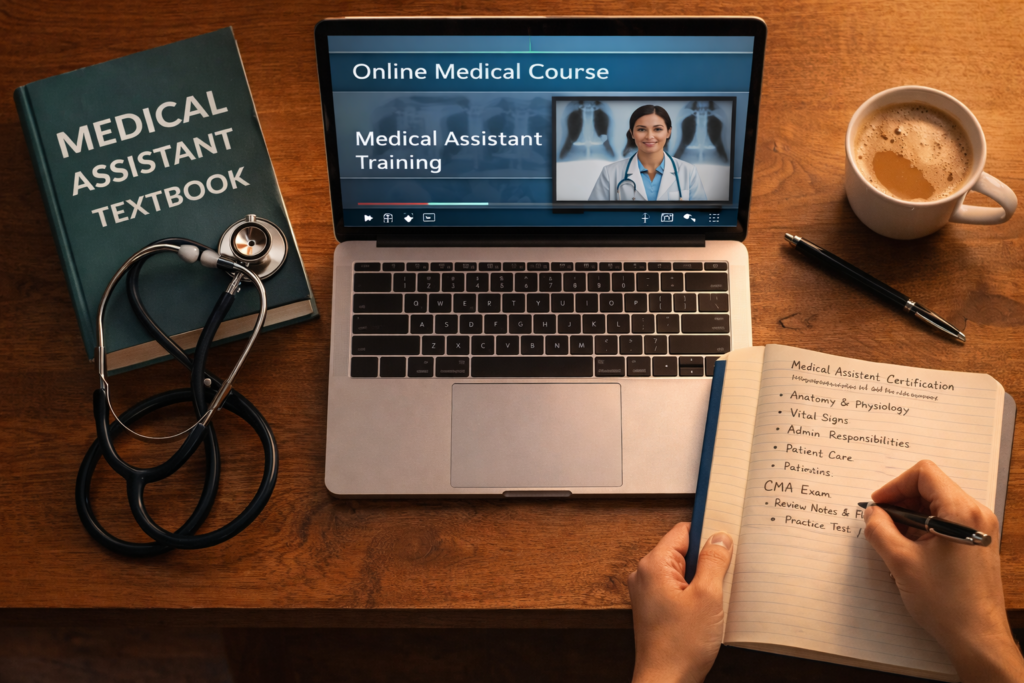
For students who need flexibility online medical assistant programs are a viable option. However, students must understand that “online” usually applies to the theoretical portion of the coursework. Anatomy, medical terminology and admin procedures can be learned online. However the clinical skills (blood draws, injections) must be learned in person. Most online programs require students to attend a local campus for intensives or arrange an approved proctor for their clinical skills.
Coursework Requirements
- Anatomy and Physiology
- Medical Terminology
- Phlebotomy
- Electrocardiography (EKG)
- Medical Law and Ethics
- Insurance Billing and Coding
- Pharmacology
Medical Assistant Certification: CMA, CCMA, and Certified Medical Assistant Explained
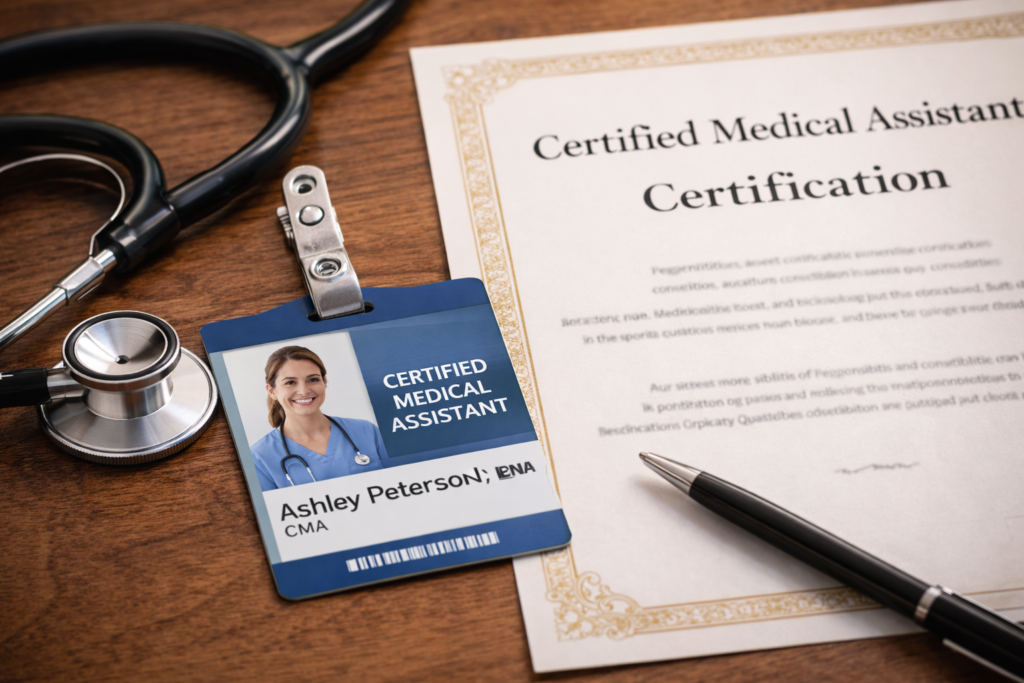
In the competitive USA job market the term certified medical assistant carries weight. Employers view certification as a safeguard for patient safety and office efficiency. There are several nationally recognized certifications but two dominate the market.
CMA (AAMA) – Certified Medical Assistant
Offered by the American Association of Medical Assistants (AAMA), the CMA is widely considered the “gold standard.”
- Requirement: Must graduate from a CAAHEP or ABHES accredited program.
- Exam: Rigorous, covering both clinical and administrative knowledge.
- Recertification: Required every 60 months through continuing education or re-examination.
- Perception: Highly respected by hospitals and large health systems.
CCMA (NHA) – Certified Clinical Medical Assistant
Offered by the National Health career Association (NHA) this certification is also widely accepted.
- Requirement: Must have completed a medical assistant training program or have 2 years of relevant work experience.
- Exam: Focuses heavily on clinical skills.
- Recertification: Required every 2 years.
Why Certification Matters
When searching for medical assistant jobs, you will notice that many listings specify “CMA or CCMA required.” Without medical assistant certification you risk your application being filtered out by Applicant Tracking Systems (ATS) before a human ever sees it. Certification demonstrates commitment and professional competence.
How Long Does It Take to Become a Medical Assistant?
For career switchers and international students, time is often the most critical variable. So, how long does it take to become a medical assistant?
The Fast Track: Diploma/Certificate
If you enroll full-time in a diploma or certificate program you can become job-ready in 9 to 12 months. This includes the time spent in the classroom and the mandatory clinical externship. For those who need to work while studying part-time options are available which can extend the duration to 18 months.
The Academic Track: Associate Degree
If you choose the Associate Degree route the timeline extends to 20 to 24 months (roughly 2 years). While this takes longer it provides a more rounded education and earns you a college degree, which may be beneficial for future career pivots into management.
The Factor of Exam Scheduling
After graduation, you must schedule and pass your certification exam. Studying for the CMA or CCMA usually takes an additional 1 to 3 months. Therefore, from day one of class to day one of a certified job the total timeline is generally 10 to 15 months for most students.
Medical Assistant Jobs for International Students in the USA
International students on F1 visas often look to healthcare as a stable career path. However, there are specific realities regarding medical assistant jobs and visa status that must be addressed honestly.
CPT (Curricular Practical Training)
Most accredited medical assistant programs include an externship. International students can utilize CPT authorization to complete this required practical training. This is legal work status that is part of the curriculum. It is the primary way international students gain USA clinical experience.
OPT (Optional Practical Training)
Upon graduation, students may be eligible for OPT, which allows them to work in the USA for 12 months (STEM majors get 24 months, but standard MAs may not qualify for the STEM extension depending on the CIP code of the program). During OPT, you can work full-time as a medical assistant.
The H1B and Sponsorship Reality
It is vital to be realistic: Medical assistant jobs rarely offer H1B visa sponsorship. Because this is an entry-level support role that typically requires a certificate or associate degree rather than a bachelor’s degree most hospitals and clinics will not sponsor a visa for it.
For international students this role is an excellent stepping stone to gain USA experience and network but it should be viewed as a bridge to further education (like Nursing or Healthcare Administration) if the goal is long-term permanent residency via employment sponsorship.
Read Also : Sugar Land Texas: The Ultimate Relocation, Financial Survival & Settlement Guide(2026)
Work Hours, Stress Level, and Work-Life Balance
A common misconception is that working in a doctor’s office is low-stress. While medical assistant jobs are less high-stakes than emergency surgery, they come with distinct pressures.
Work Hours
- Standard Clinics: Generally 8-hour shifts, 40 hours a week, Monday to Friday. (e.g., 8:00 AM to 5:00 PM).
- Urgent Care & Hospitals: Often require 12-hour shifts, rotating weekends and holidays. Night shifts are common in hospital settings.
Stress Factors
- Patient Volume: High patient volume means you are constantly moving. You may be responsible for rooming 20+ patients a day, which requires physical stamina and mental focus.
- Emotional Labor: Dealing with sick, anxious, or sometimes difficult patients requires emotional intelligence and patience.
- Multitasking: Balancing phone calls, billing, and patient care simultaneously can be mentally taxing.
Work-Life Balance
For those working in standard primary care clinics, the work-life balance is one of the best in healthcare. You generally have evenings and weekends off, allowing for family time or further education.
Career Growth After Medical Assistant Job
Starting as a medical assistant is rarely the end of the road. The USA healthcare system values internal promotion, and experience in this role opens several doors.

Vertical Growth
- Lead Medical Assistant: With 3-5 years of experience, you can oversee a team of MAs, handling scheduling and training.
- Clinical Office Manager: This administrative role focuses on the operations of the clinic. Your background as an MA gives you the credibility to manage clinical staff effectively.
- Medical Assistant Instructor: Experienced MAs can return to vocational schools to teach the next generation.
Lateral Mobility (Bridging Roles)
Many MAs use the role as a “pre-nursing” career.
- Nursing (RN/LPN): The clinical experience gained as an MA gives students a significant advantage in nursing school and helps them secure jobs as Patient Care Technicians (PCTs) while studying.
- Medical Records Technician: Transitioning fully into the administrative side, focusing on Health Information Management (HIM).
- Phlebotomy Technician: Specializing strictly in blood draw labs.
Salary Growth
While the entry-level medical assistant salary is moderate, moving into management or specialized roles can push earnings closer to the $60,000 – $70,000 range, significantly improving ROI.
Read Also : Warehouse Jobs in USA 2026: Salary, Job Requirements & Real Hiring Truth
FAQ Section
What does a medical assistant do?
A medical assistant performs a mix of administrative and clinical tasks to support healthcare providers. This includes taking vital signs drawing blood, administering injections, scheduling appointments, and managing patient records.
How much do medical assistants make in the USA?
The median annual wage is approximately $42,000 to $45,000. Hourly rates typically range from $17.00 for entry-level positions to over $25.00 for experienced or certified professionals with higher wages in states like California and Washington.
How long does it take to become a medical assistant?
It typically takes 9 to 12 months to complete a diploma or certificate program. An Associate Degree takes about 2 years. Including certification exams most students enter the workforce within 10 to 15 months of starting school.
How to become a medical assistant in the USA?
You must complete a post-secondary education program (diploma, certificate, or associate degree), finish a clinical externship, and pass a national certification exam (such as the CMA or CCMA) to become employable.
Do you need certification to become a medical assistant?
Certification is not legally required in all states, but it is highly recommended. Over 90% of employers prefer to hire a certified medical assistant (CMA or CCMA) because it verifies skills and knowledge, leading to better job prospects and higher pay.
Are medical assistant jobs good for international students?
Yes, for gaining experience via CPT/OPT. However, medical assistant jobs rarely offer H1B visa sponsorship because it is considered a support role. It is an excellent bridge for international students to gain USA work experience but usually not a long-term visa solution.
Final Thoughts: Should You Become a Medical Assistant in the USA?
The decision to pursue a career as a medical assistant should be based on your timeline and career goals. If you are looking for a stable, in-demand job that allows you to start working quickly without spending four years in college, this is an excellent choice. It provides a solid foundation in healthcare and serves as a stepping stone to advanced roles like nursing or practice management.
For international students, it offers a legitimate pathway to gain US work experience through CPT and OPT, provided the goal is aligned with further education. By selecting the right medical assistant programs and obtaining your certified medical assistant credential, you position yourself competitively in a growing market. Research medical assistant jobs near me to see local demand, and if the salary and duties align with your lifestyle, take the next step and enroll in an accredited course.
Read Also : Truck Driver Job in USA: Salary, CDL Cost, Visa & Best Companies Hiring (2026)