
If you’re researching the University of Missouri Columbia you’re likely comparing tuition costs, ROI and real campus life beyond marketing photos. College decisions aren’t just about rankings they impact your finances and career for years. Mizzou is popular in the Midwest because it offers a true flagship university experience at a far more affordable cost than private or coastal schools. Whether you’re a U.S. student weighing in state value or an international student calculating visa and ROI factors this guide focuses on the real practical side of studying at Mizzou.
Introduction: Why Students Search for University of Missouri Columbia
The search volume for the University of Missouri Columbia spikes every admission season for a reason. It is often viewed as the “Goldilocks” school not impossible to get into but not a diploma mill either.
For US students, particularly in Missouri and neighboring states it’s about access to top tier research (the R1 classification) and massive alumni networks without leaving the region.
For international students the intent is practical. They are looking at the University of Missouri Columbia USA because they want a safe authentic American college town that is affordable compared to New York or California.
Reality Check: Cost vs. Value
Mizzou is a solid investment, but only if you are strategic. The “value” here isn’t just in the degree; it’s in the network. However if you are taking out massive loans for a low-ROI degree you need to pause and calculate carefully. The University of Missouri Columbia offers high ROI for STEM, Business and Journalism majors but perhaps less so for general degrees without a clear career plan.
University of Missouri Columbia Location & Campus Life
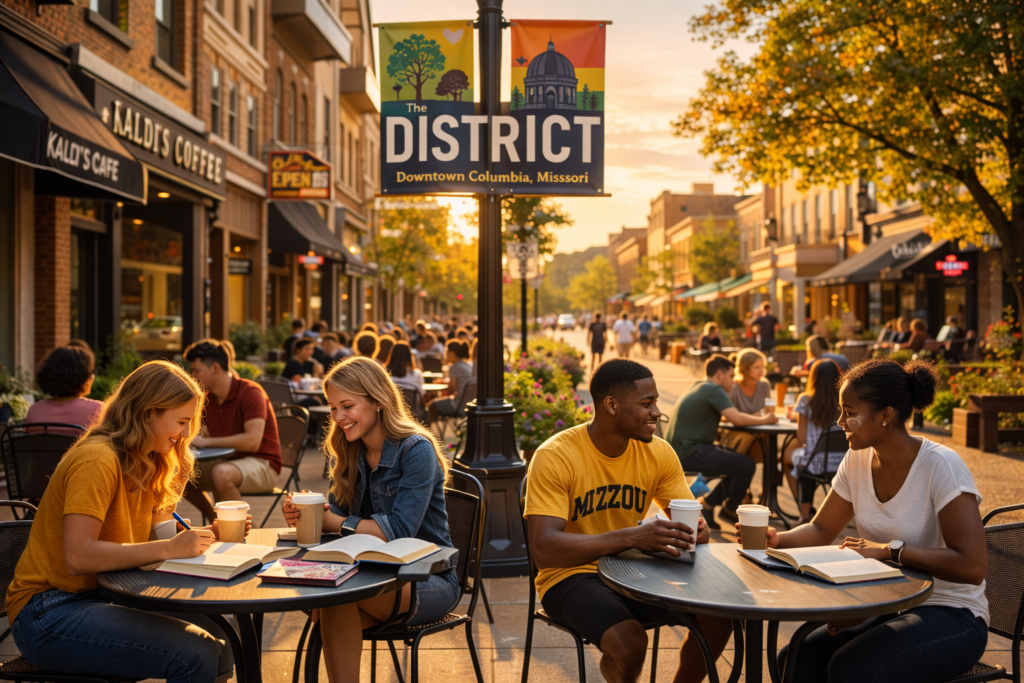
You cannot understand the University of Missouri Columbia without understanding Columbia, Missouri.
Columbia Missouri Location Advantages Locals call it “CoMo.” It is a classic college town located almost exactly in the middle of the US.
- Access: It’s roughly two hours from Kansas City and two hours from St. Louis. This gives you access to big-city internships and airports without paying big city rent.
- Vibe: The city’s economy relies heavily on the university. The community is student-friendly but it also means the town can feel quiet during breaks.
Weather Reality
Do not underestimate the Midwest weather.
- Summer: It is hot, humid and sticky. You will sweat walking to class in August.
- Winter: It is cold and windy. Snow isn’t constant, but the wind chill cuts through your jacket.
- Tornado Season: This is a real thing in Missouri. You will participate in tornado drills.
Safety & Crime Reality
Is safety in Columbia Missouri for students a concern? Generally it is safe. The campus has its own police force (MUPD) and blue-light emergency phones are everywhere.
- The Real Issue: Property theft. Bikes get stolen. Left-out laptops disappear. Use common sense.
- Nightlife: The downtown area gets rowdy on weekends. Most incidents are alcohol-related rather than violent crime against random students.
Read Also : University of Kentucky Fees, Acceptance Rate, Housing & Job Opportunities
University of Missouri Columbia Admission Process (USA & International Students)
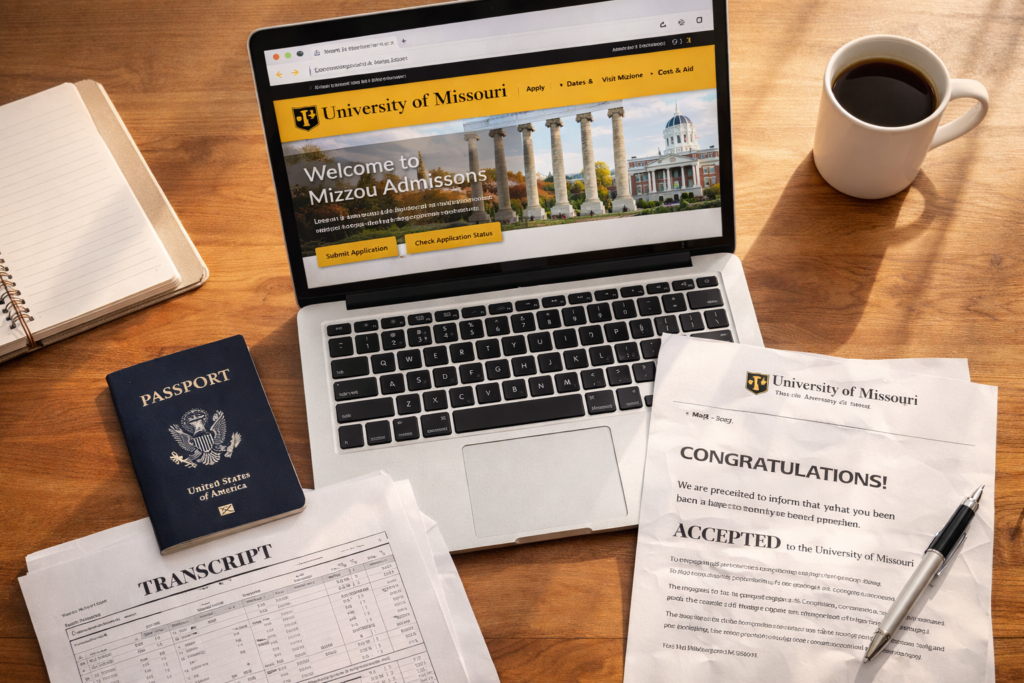
The University of Missouri Columbia application process is streamlined but you need to watch the deadlines like a hawk. Mizzou operates on a rolling admission basis but “rolling” doesn’t mean “infinite.”
When Admissions Start
- Fall Semester (August): Applications open August 1st of the previous year. Priority deadlines are usually in December or March for scholarships.
- Spring Semester (January): Applications are generally due by October.
University of Missouri Columbia Acceptance Rate Reality
The acceptance rate hovers around 70-80%.
- For US Students: If you have a decent GPA (3.0+) and meet the curriculum requirements, you are likely getting in.
- For International Students: It is slightly more competitive due to limited seating and English proficiency requirements but still accessible compared to top-tier schools.
- How Competitive is it Really? It’s not a “reach” school for the average student, but getting into specific colleges (like Nursing or Journalism) is much harder than getting into General Arts & Sciences.
University of Missouri Columbia Eligibility & Qualification Requirements
The University of Missouri Columbia looks at your “Core GPA” rather than just your cumulative GPA. They focus on the classes that matter (Math, Science, English, Social Studies).
For US Students:
- Minimum GPA: Generally, a 2.5 core GPA is the floor, but 3.0+ is where you want to be to be safe.
- Class Rank: Being in the top 25% of your class helps significantly for merit aid.
For International Students:
- Academic Standards: You need the equivalent of a US high school diploma. Mizzou evaluates transcripts rigorously.
- Gap Acceptance Reality: The University of Missouri Columbia is relatively open to gap years. However, if you have a gap of more than 2-3 years, you may need to provide a statement of explanation or work experience proof.
Read Also : University of Tennessee Knoxville Student Survival Guide: Real Cost, Jobs, Housing & Safety Reality
English & Other Tests Required at University of Missouri Columbia
If you are an international applicant your English proficiency is the biggest hurdle.
- IELTS Requirement: You generally need a minimum overall band score of 6.5, with no section lower than 6.0. Competitive programs (like Business or Journalism) might ask for 7.0.
- TOEFL Requirement: The minimum is usually 79 (iBT). Again, aiming for 100+ makes you a much stronger candidate for funding.
- Duolingo Accepted or Not? Yes, post-COVID, the University of Missouri Columbia Duolingo test is accepted. You typically need a score of around 105-115. Always check the specific department page as they update these requirements annually.
- GRE / GMAT:
- Undergrads: SAT/ACT are now “test-optional” for many programs, but submitting a good score can still help with scholarships.
- Graduates: GRE is required for most Engineering and Sciences masters. GMAT is required for the Business school (Trulaske), though they sometimes offer waivers for high-GPA students.
University of Missouri Columbia Tuition Fees & Hidden Costs
Let’s talk money. The sticker price can be scary but the “net price” is often lower.
University of Missouri Columbia Tuition Fees
- Resident (Missouri): Approx. $11,000 – $12,000 per year.
- Non-Resident (USA): Approx. $28,000 – $30,000 per year.
- International: Approx. $30,000 – $32,000 per year.
Mandatory University Fees
This is where students get surprised. You will pay for the recreation center student activity fees technology fees, and library fees. This can add up to $1,500 – $2,000 extra per year that is not tuition.
Books, Transport, Food
- Books: $1,200/year (Rent or buy used, do not buy new from the bookstore).
- Transport: The city bus system is free for students with your ID card. You do not need a car which saves thousands.

University of Missouri Columbia Visa Process for International Students (F-1)
If you are reading this as an international student, the visa process is the most stressful part of the University of Missouri Columbia admission for international students.
- Get the I-20: Once you are admitted and show proof of funds, Mizzou issues the I-20.
- SEVIS Fee: Pay the $350 SEVIS fee.
- DS-160: Fill out the visa application form online.
- Visa Interview Reality: This happens at the US Embassy in your home country.
University of Missouri Columbia I20 Process
The consular officer wants to know two things: Are you a real student? Do you have enough money?
Common Rejection Reasons: Looking nervous not knowing basic facts about your major or having bank statements that look like loans were taken out just yesterday (funds must be “liquid” and available).
Financial Proof & Funds Requirement
To get the I-20, you have to show proof of funds for the first year only. However, for the visa interview you must show you can pay for all years.
- Total Show Money Needed: Roughly $45,000 – $50,000 USD (Tuition + Living Expenses).
- Liquid Cash vs. Fixed Deposit:
- Liquid cash (checking/savings) is best.
- Fixed Deposits (FDs) are accepted, but officers prefer funds that are not “locked” away indefinitely.
- Education Loan Accepted: Yes an approved loan sanction letter works perfectly for visa interviews. You do not need to disburse the loan, just show approval.
Cost of Living Near University of Missouri Columbia
This is one of the biggest selling points. Compared to NYC or LA, the cost of living in Columbia Missouri for students is very reasonable.
Rent Near University of Missouri Columbia
- On-Campus: Dorms cost between $8,000 – $10,000 per year (meal plan included).
- Off-Campus:
- 1 Bedroom (Alone): $700 – $900/month.
- Shared Apartment (3-4 Bed): $400 – $550/month per person.
- Popular Areas: “The Highlands” and “Campus Club” are popular student housing complexes. They are pricey but include furniture and utilities.
Monthly Food Expense
If you cook at home, groceries can cost $200 – $300/month. If you eat out daily expect to spend $600+.
Part-Time Jobs at University of Missouri Columbia
This is the section every student worries about. Can you survive financially?
On-Campus Jobs University of Missouri Columbia
- Availability: Yes, but they are competitive. International students (F-1) can only work on-campus for the first 9 months.
- Hourly Pay: The Missouri minimum wage is currently around $12.00 – $13.00/hour.
- Where to Apply: Dining halls (Sodexo), Ellis Library, the Rec Center, and administrative desks.
- Hours: Max 20 hours/week during semester. You can earn roughly $400-$800 a month depending on hours.
Off-Campus Jobs in Columbia Missouri
- Legally Allowed? Only after you have completed one academic year and applied for CPT or OPT OR if it is at an affiliated organization off-campus.
- The Reality: Many students work cash-in-hand jobs at local restaurants or gas stations, but this is technically illegal under F-1 visa rules and carries a deportation risk. Stick to on-campus jobs until you get proper authorization (CPT/OPT).

Read Also :Cary North Carolina – Living Cost, Jobs, Apartments, Student Housing & Real Survival Guide (2026)
Healthcare & Insurance for University of Missouri Columbia Students
University Health Center
Mizzou has the Student Health Center. It’s convenient for flu shots, basic check-ups, and prescriptions.
Why Insurance is Mandatory
The US healthcare system is expensive. If you break a leg or need surgery without insurance, you could be in debt for years.
- Cost: The university has a mandatory insurance plan unless you can prove you have comparable coverage.
- International Students: You are automatically enrolled in the University of Missouri Columbia student insurance plan. It costs roughly $2,000 – $3,000 per year. This is high, but it covers almost everything.
After Graduation Options & ROI from University of Missouri Columbia
You are coming here to get a job. So what does the University of Missouri Columbia offer after graduation?
- CPT (Curricular Practical Training): Used for internships during your studies. You must get a job offer that is related to your major.
- OPT (Optional Practical Training): Used after graduation. All students get 12 months of work authorization.
STEM OPT University of Missouri Columbia
This is crucial. If your major is STEM designated (Science, Technology, Engineering, Math) you get an additional 24 months of OPT.
Salary after Graduation: The salary after graduation University of Missouri Columbia varies by major.
- Engineering/CS: $70,000 – $90,000+
- Business: $55,000 – $75,000
- Journalism/Arts: $35,000 – $50,000
Jobs after Graduation University of Missouri Columbia
The career center hosts career fairs but don’t expect them to hand you a job. You have to network.

Government & Corporate Job Options After University of Missouri Columbia
Can International Students Get US Government Jobs?
The short answer is NO. Federal government jobs (FBI, USDA, etc.) almost always require US Citizenship.
- Exception: Very specific contractor roles might take H1B, but it is rare.
Corporate Sectors Hiring Graduates
- Healthcare: The hospital system in Columbia and surrounding areas (Kansas City/St. Louis) is massive.
- Agriculture & Bio-Tech: Monsanto (Bayer) and Cargil hire from Mizzou.
- Engineering: Burns & McDonnell (Kansas City) is a huge recruiter for Mizzou engineers.
- Corporate: Many tech and finance companies recruit from the Business school.
Corporate Jobs after MS in USA
For international students, the goal is to get a company that sponsors H1B visas. Big corporations (IBM, Deloitte, etc.) are safer bets than small local startups.
Read ALSO : Customer Service Representative Jobs in USA: The 2026 High-Paying Guide
Final Verdict: Is University of Missouri Columbia Worth It?
So who is the University of Missouri Columbia actually for?
Who Should Choose It:
- Students who want a genuine “American college” experience without the chaos of a massive city.
- Students looking for strong programs in Journalism, Nursing Engineering, or Agriculture.
- International students who want a safer environment and lower cost of living compared to coastal states.
- Students who are willing to work hard on-campus jobs to manage their expenses.
Who Should NOT Choose It:
- Students who want a “party school” vacation. Academics are rigorous, especially in the upper divisions.
- Students who hate winter and small towns. If you need a subway and skyscrapers to be happy, go to NYC or Chicago.
- International students relying entirely on illegal off-campus work to survive. The risk is too high.
Frequently Asked Questions :
Is the University of Missouri Columbia good for international students?
Yes, especially for students seeking lower living costs and strong STEM or professional programs.
What is the acceptance rate at University of Missouri Columbia?
Typically around 70–80%, depending on the program.
How much money is required for the I-20 and visa process?
Roughly USD 45,000–50,000 for the first year, including tuition and living expenses.
Can international students work off-campus at Mizzou?
Only with proper authorization such as CPT or OPT. Unauthorized work is illegal.
What are the average salaries after graduation?
Engineering and CS graduates often earn USD 70,000+, while other fields vary.
Is Columbia Missouri safe for students?
Yes, with common-sense precautions, especially regarding property theft.