
College affordability in the United States has shifted from a background concern to the central decision factor for families in 2026. Public university tuition continues to rise incrementally each year while student loan balances nationally exceed $1.7 trillion. For middle class households earning $60,000–$120,000 annually, choosing a university like the University of Kansas is no longer about campus culture or athletics. It is about total cost of attendance student loan risk graduate salary outcomes, job placement rates, and long-term return on investment. Every dollar borrowed must translate into employable skills and competitive income within the first five years after graduation.
The University of Kansas (KU) is the flagship public university of Kansas and an R1 research institution. That designation signals strong research output, but research prestige does not automatically equal financial efficiency for students. In 2026, the key questions are practical: How much does KU really cost? What is the acceptance rate? How competitive are admissions? What do graduates actually earn? And most importantly, is KU financially worth it compared to nearby public universities?
This data-driven analysis focuses on tuition 2026 figures cost of attendance breakdown, salary outcomes by major, international student visa pathways, scholarship impact employment statistics and regional comparisons. The goal is to determine whether KU represents a smart financial investment for U.S. residents and international students evaluating ROI-based education decisions.
Basic Overview
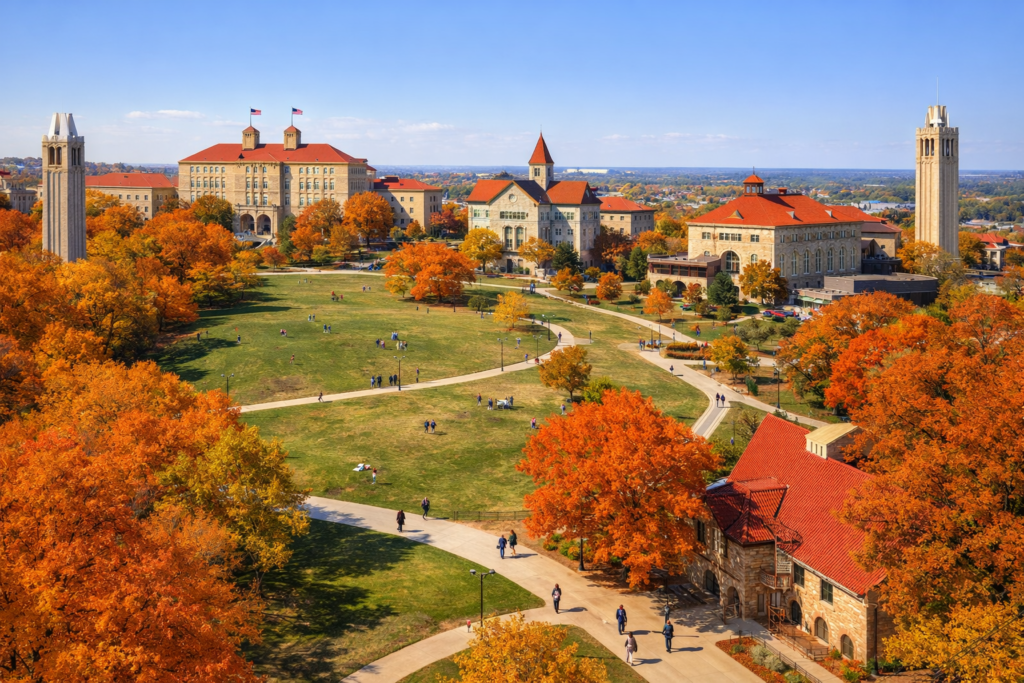
The University of Kansas was founded in 1865 and operates as a public research university under the Kansas Board of Regents. It is located in Lawrence, Kansas, approximately 40 miles west of Kansas City. KU is considered the flagship public institution of the state and enrolls roughly 27,000–30,000 students across undergraduate, graduate, and professional programs.
- Location: Lawrence, Kansas
- Founded: 1865
- Institution Type: Public, R1 research university
- Total Enrollment: ~27,000–30,000
- Campus Type: Residential, small-city setting
- Research Classification: Very High Research Activity
As a public institution, KU’s tuition structure heavily favors Kansas residents. Out-of-state and international students pay significantly higher tuition rates, which alters ROI calculations dramatically.
Read Also : University of Nebraska Lincoln (UNL): Complete Overview for US & International Students (2025–26)
Where Is University of Kansas Located? Cost of Living Impact
KU is located in Lawrence, Kansas a traditional college town where the university drives the local economy. Unlike large metropolitan universities in cities like Chicago or Los Angeles Lawrence offers a lower cost of living, which positively affects student housing and daily expenses.
2026 Estimated Cost of Living in Lawrence:
- Shared apartment: $500–$800/month
- One-bedroom apartment: $900–$1,200/month
- Utilities: $120–$180/month
- Groceries: $300–$400/month
- Transportation: Lower than national urban average
Compared to national metro averages Lawrence is affordable. However housing and living expenses still add $12,000–$16,000 per year to total education costs.
Proximity to Kansas City enhances internship access in finance healthcare, logistics, engineering, and corporate sectors, which improves employment prospects after graduation.

University of Kansas Tuition 2026 & Total Cost of Attendance
Tuition alone does not reflect true cost. Total cost of attendance (COA) includes tuition housing food, books transportation and personal expenses.
2026 Estimated Tuition:
- In-State Tuition: ~$11,500 per year
- Out-of-State Tuition: ~$30,000–$31,000 per year
- International Tuition: ~$30,000+ per year
Additional Annual Costs:
- Housing & Meal Plan: $10,000–$14,000
- Books & Supplies: $1,000–$1,200
- Personal Expenses: $2,500–$3,000
- Transportation: $1,000–$1,500
Estimated Total Annual Cost:
- In-State Total: $25,000–$30,000
- Out-of-State / International Total: $43,000–$48,000
Four-Year Cost Projection:
- In-State: ~$100,000–$120,000
- Out-of-State / International: ~$175,000–$190,000
This projection assumes no tuition increases which historically occur annually. Inflation-adjusted costs could push total expenses slightly higher by graduation year.
Read Also : Oklahoma State University 2026: Fees Jobs After Graduation & OPT for International Students
University of Kansas Scholarships & Financial Aid Impact (2026)
Financial aid significantly affects net price. KU offers merit-based scholarships for in state and out-of-state students, as well as need-based grants.
Average Aid Impact:
- Many in-state students reduce net cost to $18,000–$22,000 per year.
- Out-of-state students must secure competitive merit scholarships to reduce annual cost below $35,000.
Students should evaluate:
- Renewable merit scholarships
- Departmental scholarships
- Federal Pell Grants
- Work-study opportunities
- Scholarships can dramatically improve salary-to-debt ratio and shorten repayment timelines.

Acceptance Rate & Admission Data (2026)
KU maintains a relatively high acceptance rate making it accessible for students meeting academic benchmarks.
- Acceptance Rate: ~88%–92%
- Average GPA: 3.3–3.6
- SAT Range: 1090–1280
- ACT Range: 20–28
- Admission Type: Rolling
The high acceptance rate indicates moderate selectivity. Students with solid academic performance generally gain admission but competitive programs like engineering and nursing may require stronger academic profiles.
University of Kansas Ranking & Academic Strength
KU is nationally ranked among public research universities. While it is not a top-20 public university like some flagships it maintains strong regional recognition and R1 research classification.
High-performing academic areas include:
- Engineering
- Business (especially accounting & finance)
- Nursing
- Pharmacy
- Special Education

Ranking matters for long-term brand recognition but ROI depends more heavily on major selection and internship access than overall ranking position.
Popular Majors & Salary Outcomes 2026
Major choice directly influences financial return.
Top High-Demand Majors:
- Business Administration
- Finance
- Accounting
- Engineering (Mechanical, Civil, Electrical)
- Nursing
- Marketing
- Computer Science
Average Starting Salaries:
- Engineering: $65,000–$75,000
- Nursing: $60,000–$70,000
- Finance & Accounting: $55,000–$65,000
- Marketing: $50,000–$60,000
- Humanities & Social Sciences: $40,000–$50,000
Salary Growth Outlook:
Within 5–7 years:
- Engineering graduates may exceed $90,000–$110,000
- Finance professionals may cross $80,000–$95,000
- Healthcare fields show strong job stability
STEM majors qualify for higher income and STEM OPT extension (for international students), making them financially superior pathways.
Read Also : Is Bloomington, Indiana Worth Living In? Cost of Living, Jobs & Housing Reality (2026)
University of Kansas Employment Rate & Job Placement Data
Approximately 90–96% of graduates report employment or continued education within six months of graduation.
KU’s career services infrastructure connects students to:
- Regional corporate employers
- Healthcare systems
- Engineering firms
- Government agencies
- Kansas City business networks
Internship participation significantly increases starting salary potential.

University of Kansas International Students: Tuition, Visa & OPT Pathways
International students pay out-of-state tuition rates.
English Proficiency Requirements:
- TOEFL: ~79+
- IELTS: ~6.5
F-1 Visa Considerations:
Students must demonstrate financial ability to cover total cost of attendance before visa approval.
Work Opportunities:
- On-campus employment: 20 hours/week
- CPT: Internship authorization
- OPT: 12 months
- STEM OPT Extension: 24 additional months
For international students paying ~$45,000 annually major selection must justify long-term income prospects.
Nearby University Comparison (Kansas & Regional Public Universities)
| Factor | University of Kansas | Kansas State University | University of Missouri |
|---|---|---|---|
| Location | Lawrence, KS | Manhattan, KS | Columbia, MO |
| Acceptance Rate | ~90% | ~95% | ~79% |
| Out-of-State Tuition | ~$30,000 | ~$28,000–$29,000 | ~$31,000 |
| Avg Graduate Salary | ~$55k–$60k | ~$52k–$58k | ~$58k–$65k |
| Research Status | R1 | R1 | R1 |
| Enrollment | ~30k | ~21k | ~31k |
| Overall ROI | Strong In-State | Strong In-State | Slightly Higher Salary Potential |
Comparative Analysis
KU offers competitive tuition among regional public universities. Missouri may show slightly higher salary averages in certain disciplines but cost differences narrow ROI margins. For Kansas residents KU remains one of the strongest public ROI options.
Salary-to-Tuition ROI Calculation
In-State ROI Scenario:
- 4-Year Cost: ~$110,000
- Starting Salary: ~$55,000
- Debt manageable within 5–8 years if borrowing under $30,000
Out-of-State ROI Scenario:
- 4-Year Cost: ~$180,000
- Starting Salary: ~$55,000
- Requires scholarship or STEM major to justify cost
Debt-to-Income Safety Rule:
Financially safe if total student debt remains below projected first-year salary.
Final Verdict: Is University of Kansas Worth It in 2026?
The University of Kansas is financially rational for Kansas residents pursuing high-demand majors. Tuition is moderate for a public R1 institution, and cost of living remains manageable compared to coastal universities.
For out-of-state and international students financial value depends heavily on scholarships and major selection. Engineering, nursing, finance, and STEM-related programs offer the strongest ROI.
Students entering low-paying fields without financial aid may experience longer repayment timelines.
KU is not an ultra-elite institution but it provides stable employment outcomes and reasonable tuition relative to comparable public universities.
Read Also : Plumber Salary in the USA (2026): Highest & Lowest Paying States, Hiring Companies, Visa Reality
Frequently Asked Questions
Where is the University of Kansas located?
The University of Kansas is located in Lawrence Kansas a city in the northeastern part of the state roughly 40 miles west of Kansas City.
What is the acceptance rate?
The acceptance rate is approximately 88%, making it a moderately accessible institution for students meeting the GPA and score requirements.
Is it good for international students?
It is good for international students in STEM fields due to OPT extensions and the affordable cost of living, though on-campus job wages are relatively low.
What is the tuition fee?
For the 2026 academic year, estimated tuition is $11,700 for in-state students and $29,400 for out-of-state and international students.
How many students attend?
Total enrollment typically exceeds 28,000 students, including both undergraduate and graduate populations.
When was it founded?
The University of Kansas was founded in 1865.
What are the popular majors?
The most popular majors include Business, Health Professions Journalism Engineering and the Social Sciences.
Is it worth it financially?
Yes, for in-state students who benefit from low tuition and competitive regional salaries. For out-of-state students it is only worth it if they secure scholarships or enter high-paying majors like Engineering.