

As we navigate toward 2026, the global financial ecosystem is undergoing a seismic shift. Driven by geopolitical tensions, the explosion of digital assets and an increasingly intricate web of international regulations the role of a Risk Analyst has transformed from a back office support function into a critical strategic imperative. The United States serving as the nerve center of the global financial system offers unparalleled opportunities in this sector. However securing these lucrative positions requires more than just a degree; it demands a deep, forensic understanding of US laws a mastery of sanctions regimes, and the ability to navigate the future of work in an AI-driven world.
This comprehensive guide is meticulously designed to serve two distinct but interconnected purposes. First, it acts as an educational masterclass for students and job seekers detailing the essential US Acts sanctions and compliance rules you must know to ace your interviews. Second it provides a strategic roadmap for the 2026 job market covering salary projections, top hiring cities major employers, and specifically how international candidates can navigate the complex visa sponsorship landscape to build their future in America.
The Educational Foundation for Every Future Risk Analyst
Before you can apply for Risk Analyst Jobs you must understand the “why” behind the role. For anyone preparing for interviews in 2026 whether a fresh graduate from a US university or an international professional the expectation from employers is clear: you must possess a working knowledge of the US regulatory environment. This section is designed to educate you on the rules of the road, ensuring you walk into any interview with the confidence of an expert.
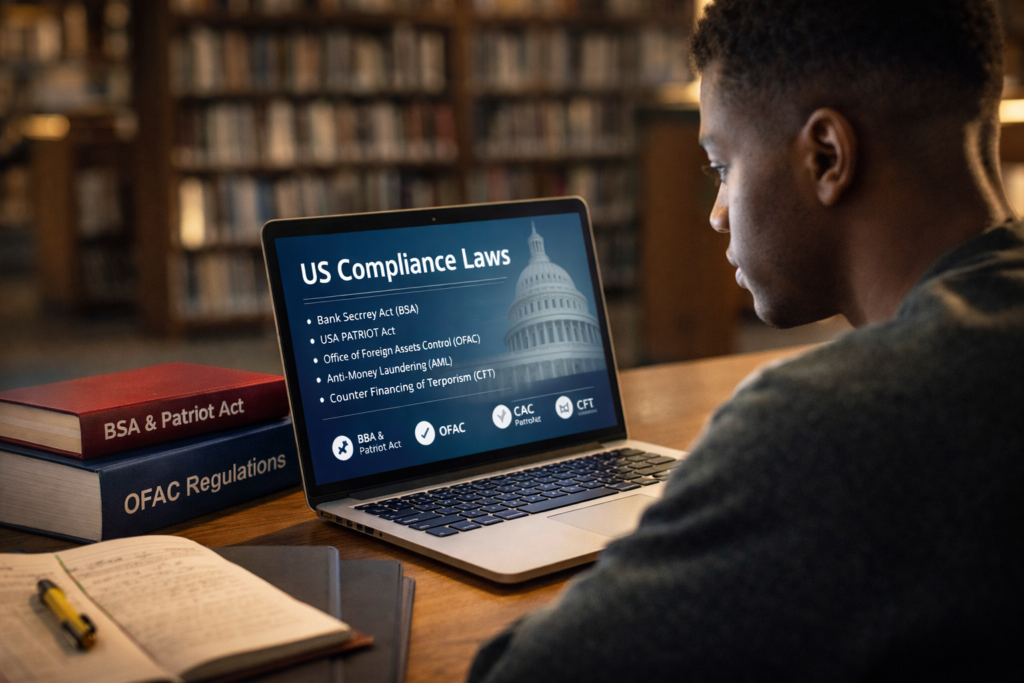
Read Also : The Complete Guide to Sanctions Analyst Jobs in USA 2026: OFAC, AML, KYC, CTR, Laws, Salary & Career Path
What Does a Risk Analyst Do Daily?
According to search data and industry trends one of the most common questions is “What does a risk analyst do?” In the context of the modern US financial sector, a Risk Analyst is a guardian of financial integrity. Their daily mission is to identify, assess, and mitigate factors that could threaten an organization’s capital or earnings.
While a general financial analyst might look at profit margins a Risk Analyst looks at potential pitfalls. This involves:
- Monitoring Transactions: Reviewing millions of financial transactions to detect anomalies that suggest money laundering or fraud.
- Conducting Due Diligence: Investigating potential clients to ensure they are not criminals or terrorists.
- Reporting: Filing necessary reports with the US government when suspicious activity is detected.
- Advising: Helping the business understand the regulatory implications of new ventures or products.
In 2026, the role is heavily data-driven. You are not just looking at paper trails; you are analyzing complex datasets to find patterns of illicit behavior.
The Global Risk Analyst Development Program Explained
For students and recent graduates, the “Global Risk Analyst Development Program” is the golden ticket to a high-flying career. These are prestigious rotational programs designed by top-tier firms to fast-track talented individuals into leadership roles. If you are targeting Risk Analyst Jobs through these programs, you can expect:
- Rotation: Spending 6-12 months in different risk sectors, such as Credit Risk, Market Risk Operational Risk and Compliance.
- Mentorship: Direct access to senior executives who guide your career trajectory.
- Fast-Tracking: Graduates of these programs often move into managerial roles 2-3 years faster than standard hires.
- Networking: Building a cohort of peers who will be future leaders in the industry.
Being accepted into a Global Risk Analyst Development Program requires academic excellence leadership potential, and a demonstrable interest in global finance.
Read Also : Forklift Operator Jobs in USA 2026: High Paying Career Guide, Salary, Visa & Future Trends
Essential US Acts and Laws for a Professional Risk Analyst
This is the most critical section for interview preparation. If you want to secure Risk Analyst Jobs in the USA you cannot simply rely on generic knowledge. You must understand the specific laws that govern the American financial system. Interviewers will test your ability to apply these laws to real-world scenarios.

How the Bank Secrecy Act (BSA) Impacts a Risk Analyst
The Bank Secrecy Act (BSA) of 1970 is the bedrock of US anti-money laundering efforts. Often referred to as the foundation of the industry, every Risk Analyst must understand its mechanics.
- The Purpose: The BSA was enacted to prevent banks from being used as tools by criminals to hide or launder money. It compels financial institutions to keep records and file reports that have a high degree of usefulness in criminal, tax, or regulatory investigations.
- Key Tools for the Analyst:
- CTRs (Currency Transaction Reports): Any cash transaction over $10,000 must be reported. As an analyst you review these to ensure no “structuring” (breaking large cash deposits into smaller amounts to avoid reporting) is occurring.
- SARs (Suspicious Activity Reports): If you suspect a customer is laundering money or evading taxes, you must file an SAR. This is a protected document; you cannot tell the customer you filed one.
- Interview Prep: Be prepared to answer: “Give an example of structuring and how the BSA helps detect it.”
Understanding the USA PATRIOT Act as a Risk Analyst
Passed after the tragic events of September 11, 2001, the USA PATRIOT Act (Uniting and Strengthening America by Providing Appropriate Tools Required to Intercept and Obstruct Terrorism Act) significantly expanded the scope of the BSA.
For a Risk Analyst this act is crucial because it intensified the focus on terrorism financing.
- Information Sharing: Section 314(b) allows financial institutions to share information with one another regarding individuals entities, or organizations that they suspect are involved in terrorist activity or money laundering. As an analyst you will collaborate with other banks to track the movement of funds.
- Prohibition of Shell Banks: The act makes it illegal for US banks to correspond with “shell banks” banks that have no physical presence in any country.
- Due Diligence: It enforced strict “Know Your Customer” (KYC) procedures. You must verify the identity of anyone opening an account to the fullest extent possible.
Navigating OFAC Regulations as a Skilled Risk Analyst
The Office of Foreign Assets Control (OFAC) is the specific body within the US Treasury Department that administers and enforces economic and trade sanctions. If you are applying for Risk Analyst Jobs, your knowledge of OFAC must be impeccable.
- The SDN List (Specially Designated Nationals): This is the “kill list” for financial transactions. It contains thousands of names of individuals, companies, vessels, and groups identified as terrorists, narcotics traffickers, or agents of proliferating countries.
- The 50% Rule: This is a favorite interview topic. Any entity owned 50% or more (directly or indirectly) by one or more blocked persons is itself considered blocked.
- Example: If Company A is owned 50% by Mr. X (who is on the SDN list), then Company A is treated as if it is on the SDN list, even if its own name is not listed. A Risk Analyst must dig into ownership structures to find these hidden connections.
- Country-Based Sanctions: You must also be aware of comprehensive embargoes (like those historically against Iran or Cuba) versus targeted sanctions.
IEEPA Knowledge Requirements for the Modern Risk Analyst
The International Emergency Economic Powers Act (IEEPA) gives the President the authority to regulate transactions after declaring a national emergency.
Why does a Risk Analyst care? Most modern sanctions programs (such as those targeting the Russian economy or specific bad actors in Venezuela) are issued under IEEPA authority. Understanding IEEPA helps you grasp why certain trade restrictions exist and how they can change rapidly based on geopolitical events. It teaches you that sanctions are dynamic tools, not static lists.
2026 Market Trends for the Ambitious Risk Analyst
With a strong legal foundation established we must look at the market itself. The demand for Risk Analyst Jobs is skyrocketing creating a candidate’s market for those with the right skills.

The Impact of AI on the Risk Analyst Role
A common fear is that Artificial Intelligence will replace the Risk Analyst. In 2026, this is not the case; instead AI is reshaping the role to be more strategic.
- Eliminating False Positives: Traditional systems flag thousands of transactions a day, 95% of which are false positives (e.g., a customer traveling abroad). AI learns customer behavior and filters these out, allowing the Risk Analyst to focus only on high-value alerts.
- Predictive Risk: Instead of reacting to fraud, AI models predict which clients are likely to commit fraud based on subtle behavioral shifts.
- The Human in the Loop: AI can process data, but it cannot understand context. If a sanctioned entity uses a complex web of shell companies to hide ownership, only a skilled human Risk Analyst can connect the dots and make the final judgment call.
Geopolitical Risks and Demand for the Risk Analyst
As the US government uses sanctions as a primary tool of foreign policy, the need for analysts who understand geopolitics has never been higher.
- Russia/Ukraine Conflict: The massive sanctions imposed on Russia have created a massive compliance burden for global banks. They need Risk Analysts who can navigate the intricacies of these restrictions.
- China Competition: With increasing scrutiny on technology transfer and investment screening, Risk Analysts in the corporate and banking sectors are vital for ensuring compliance with export controls.
High-Paying Risk Analyst Jobs and Top Employers in 2026
For those focused on the financial rewards the field offers excellent compensation. But where you work matters. Different sectors offer different cultures and pay scales.
Top Banks Hiring for Risk Analyst Positions
- Traditional banking remains the stronghold for Risk Analyst Jobs.
- JPMorgan Chase & Co: Often cited as having the “gold standard” for risk management. They hire thousands of analysts for their massive consumer and investment banking operations.
- Bank of America: Known for its strong “Global Risk” program BofA is a great place for career stability and structured growth.
- Citi Group: With a massive global footprint, Citi offers Risk Analyst Jobs that focus heavily on cross-border sanctions and international compliance.
Risk Analyst Opportunities in the Tech Sector
The highest growth area for Risk Analyst Jobs in 2026 is the technology sector.
- Fintechs (Stripe, PayPal, Square): These companies process payments for millions of merchants. They need analysts to detect fraud and ensure merchants aren’t selling illegal goods.
- Big Tech (Google, Meta, Amazon): These giants hire “Trust & Safety” analysts—a variation of the Risk Analyst role focused on platform abuse, fake accounts, and illegal content financing.
- Crypto Exchanges (Coinbase, Kraken): As crypto regulation tightens, these exchanges are desperate for Risk Analysts who understand both blockchain technology and traditional AML laws.
Top Certifications for Risk Analysts: A Comparison
| Certification | Full Name | Focus Area | Estimated Cost | Difficulty | Avg Salary Impact | Best For |
|---|---|---|---|---|---|---|
| CAMS | Certified Anti-Money Laundering Specialist | AML, Sanctions, OFAC | $1,500–$2,000 | Intermediate | +$15K–$25K | AML / Sanctions Analysts |
| CRCM | Certified Regulatory Compliance Manager | US Banking Regulations | $1,000–$1,500 | Advanced | +$10K–$20K | US Domestic Compliance |
| FRM | Financial Risk Manager | Market & Credit Risk | $1,200+ | Very High | +$20K–$35K | Investment Banking Risk |
| CIA | Certified Internal Auditor | Internal Controls, Ops Risk | $1,000–$1,200 | Intermediate | +$10K–$18K | Internal Audit / Ops Risk |
| CFA | Chartered Financial Analyst | Portfolio & Investment Analysis | $2,500+ | Extremely High | +$25K–$40K | Credit Risk / Asset Mgmt |
Risk Analyst Salary Guide and US Cost of Living
Understanding your market value is key. “How much do risk analysts make?” is a critical question for any applicant. In 2026, salaries are robust, but location plays a huge role.

How Much Do Risk Analyst Jobs Pay in 2026?
Salary data for Risk Analyst Jobs shows a clear correlation between specialization and pay.
- Entry Level (Junior Risk Analyst): $65,000 – $85,000. This range applies to recent grads or those with 0-2 years of experience.
- Mid-Level (Sanctions/AML Analyst): $95,000 – $125,000. Once you have your CAMS certification and 3-5 years of experience, you enter this bracket.
- Senior Level (VP of Compliance / Manager): $140,000 – $200,000+. At this level you manage teams and strategies. Bonuses can add another 20-30% to these figures.
Cost of Living vs. Risk Analyst Pay Scale
When evaluating Risk Analyst Jobs you must look at the “Purchasing Power” of the salary.
- New York City (Manhattan): The hub of finance. Salaries here are often 20% higher than the national average. However, rent and living costs are astronomical. A Risk Analyst earning $100k in NYC lives similarly to one earning $55k in Ohio.
- Charlotte, North Carolina: A rapidly growing banking hub (home to Bank of America and Wells Fargo operations). Salaries are competitive (often $90k+), but housing is affordable. This allows for higher savings rates.
- Wilmington, Delaware: Many credit card issuers (like Chase) are based here. It offers a high concentration of Risk Analyst Jobs with a reasonable cost of living.
- San Francisco / Bay Area: Tech roles here pay the highest (often $130k+ for mid-level), but competition is fierce and living costs are the highest in the nation.
How Foreigners Can Secure Risk Analyst Jobs and Visa Sponsorship
For the 30% of our audience comprising international students and foreign professionals, the US is the ultimate destination. The good news is that Risk Analyst Jobs are classified as “Specialty Occupations,” making them eligible for work visas. However, the path requires strategic planning.

The F-1 to OPT to H-1B Path for a Risk Analyst
- F-1 Visa: Enroll in a US Master’s program (Finance, Business Analytics, or Economics). A STEM (Science, Technology Engineering, Math) designated degree is preferred because it grants a longer work period.
- OPT (Optional Practical Training): After graduation, you get 12 months of work authorization. STEM majors get an additional 24 months (total 36 months). Use this time to get hired for Risk Analyst Jobs.
- H-1B Lottery: While on OPT, your employer applies for the H-1B visa. If selected, you can stay in the US for 3-6 years.
H-1B Visa Sponsorship for Risk Analyst Jobs
Not all companies sponsor. For Risk Analyst Jobs, you should target firms with a history of sponsorship:
- The “Big 4” (Deloitte, PwC, EY, KPMG): These consulting firms have massive immigration legal teams and frequently hire international graduates for their risk consulting practices.
- Global Banks (Citi, HSBC, Standard Chartered): Being international entities themselves, they are more accustomed to visa processes than domestic regional banks.
L-1 Visa Options for the International Risk Analyst
If you are already working outside the US the L-1 Visa (Intra-company Transferee) is your best bet.
- The Strategy: Get hired by a multinational bank or consulting firm in your home country (e.g., India, UK, Brazil). Work for them for at least one continuous year.
- The Transfer: Apply to transfer to their US office. This visa does not require a lottery and is valid for 3-5 years. This is a highly reliable way to secure Risk Analyst Jobs in the USA without the uncertainty of the H-1B lottery.
TN Visa Status for Canadian and Mexican Risk Analyst Candidates
Under the USMCA (formerly NAFTA) Canadian and Mexican citizens have a streamlined path.
- The Category: “Management Consultant” or “Economist” are often acceptable categories for a Risk Analyst.
- The Benefit: This visa is renewable indefinitely (in 3-year increments) and does not require a petition or lottery. You can obtain it directly at the border (for Canadians) or via consulate (for Mexicans).
Best Cities and Portals to Find Risk Analyst Jobs
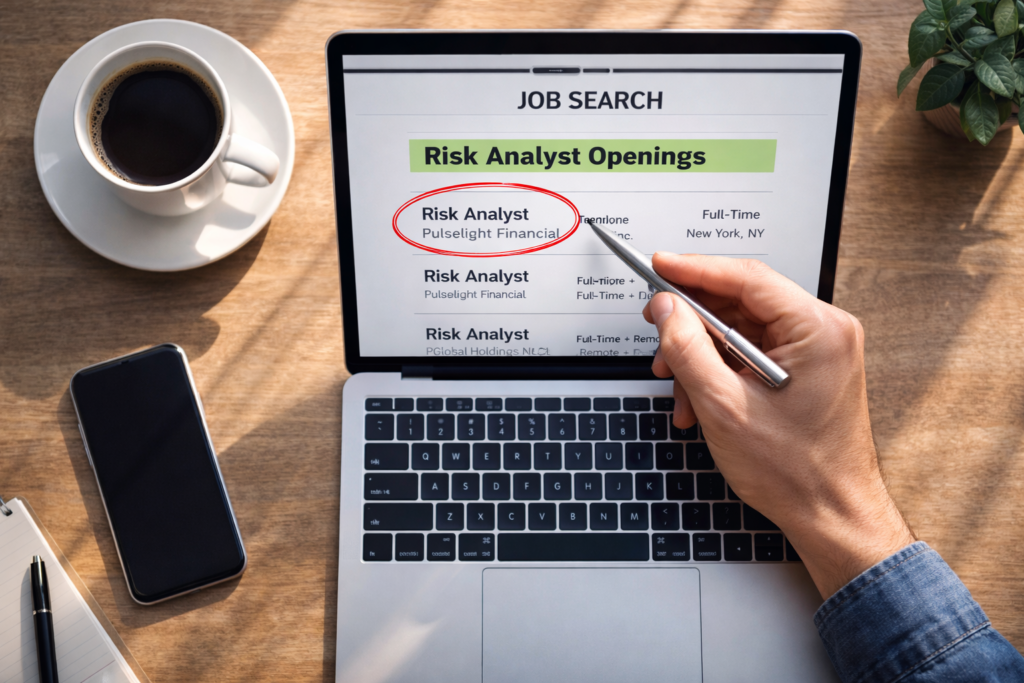
Knowing where to look is as important as knowing what to study.
Best US Hubs for a Risk Analyst Career
- New York City, NY: The undisputed capital of finance. Home to Wall Street, the NY Fed, and nearly every major investment bank.
- Charlotte, NC: The second-largest banking center in the US. A great place for Risk Analyst Jobs focused on retail and consumer banking.
- Chicago, IL: A hub for derivatives trading and insurance (CME Group, Allstate). Great for Risk Analysts interested in market risk.
- Washington, DC: The home of regulation. Jobs here are often with the World Bank, IMF, or regulatory bodies, focusing on policy rather than commercial banking.
Best Portals to Find Risk Analyst Openings
- LinkedIn: The #1 tool. Use keywords like “Sanctions Analyst,” “AML Investigator,” and “Global Risk Analyst Development Program.” Connect with recruiters.
- USAJOBS.gov: The official portal for the US Federal Government. If you want to work as a Risk Analyst for the Federal Reserve, the Treasury (OFAC), or the SEC, this is the only place to apply. These jobs offer incredible stability and pensions.
- eFinancialCareers: A niche job board specifically for high finance. It is less cluttered than general boards and attracts high-quality Risk Analyst listings.
- ACAMS Career Center: The professional body for Anti-Money Laundering specialists. Jobs posted here are serious, compliance-focused roles.

Frequently Asked Questions for Every Risk Analyst
What is the primary role of a Risk Analyst in the US banking sector?
A Risk Analyst in US banking serves as the primary defense against financial crimes and instability. Their role involves monitoring transactions for signs of money laundering (AML), ensuring clients are not on sanctions lists (OFAC compliance), assessing the creditworthiness of borrowers, and reporting suspicious activities to the government via SARs. They ensure the bank operates within the strict legal frameworks set by the BSA and Patriot Act.
2. What are the essential US Acts I need to know for a Risk Analyst interview?
To ace a Risk Analyst interview, you must have a deep understanding of the Bank Secrecy Act (BSA), the foundation of US anti-money laundering laws; the USA PATRIOT Act, which focuses on terrorism financing and information sharing; and regulations from OFAC (Office of Foreign Assets Control), which enforce economic sanctions. You should also be familiar with IEEPA, which grants the President powers to regulate transactions during national emergencies.
3. How much do Risk Analysts make in the USA in 2026?
In 2026, the salary for Risk Analyst Jobs is highly competitive. Entry-level analysts can expect to earn between $65,000 and $85,000 annually. Mid-level professionals with 3-5 years of experience or certifications (like CAMS) can command salaries ranging from $95,000 to $125,000. Senior managers and VPs in major hubs like New York or San Francisco can earn $150,000 to $200,000+, excluding performance bonuses.
4. Can international students get sponsored for Risk Analyst Jobs?
Yes, international students are highly sought after for Risk Analyst Jobs, particularly in areas like Sanctions and AML where knowledge of foreign languages and cultures is a distinct advantage. Large banks and the “Big 4” accounting firms are the most reliable sponsors for H-1B visas. Students should leverage their OPT (Optional Practical Training) period to gain experience and prove their value to potential sponsors.
5. What is the “Global Risk Analyst Development Program”?
The Global Risk Analyst Development Program is a prestigious entry-level rotational program offered by top financial institutions (like JPMorgan or Bank of America). It is designed to fast-track high-potential graduates into leadership roles. Participants rotate through different risk departments (Credit, Market, Operational, Compliance) over 2-3 years, gaining a holistic view of the bank before settling into a permanent Risk Analyst position.
6. How is AI changing the Risk Analyst job market?
AI is automating the repetitive, data-heavy aspects of risk management such as filtering thousands of transaction alerts. This shifts the Risk Analyst role from data entry to complex investigation. Instead of manually checking every alert, analysts in 2026 use AI tools to predict risk patterns and focus on the most complex, high-value cases that require human judgment and nuanced understanding of sanctions.
7. Which US cities offer the best opportunities for Risk Analysts?
While New York City is the finance capital offering the highest salaries, cities like Charlotte, NC (banking hub), Wilmington, DE (credit card hub), and Chicago, IL (derivatives/insurance hub) offer excellent opportunities for Risk Analysts. These cities often provide a better cost-of-living ratio, allowing analysts to save more money compared to living in NYC or San Francisco.
8. What is the difference between AML and Sanctions Analysis?
While both are subsets of compliance, they differ in focus. AML (Anti-Money Laundering) focuses on the method of crime—detecting patterns of money laundering, structuring cash deposits, or layering transactions. Sanctions Analysis focuses on the entity involved—screening names against the OFAC SDN list to ensure the company is not doing business with blocked individuals, countries, or terrorists. A Risk Analyst often works in both domains.
Conclusion
The landscape for Risk Analyst Jobs in 2026 is one of immense opportunity and critical importance. As the financial world becomes more digital and interconnected, the need for vigilant, educated professionals to safeguard the system has never been greater. Whether you are a US student aiming for Wall Street or an international candidate navigating the visa process, the path to success lies in education and specialization.
By mastering the US Acts—the BSA, Patriot Act, and OFAC regulations you distinguish yourself from the competition. By understanding the dynamics of the Global Risk Analyst Development Program and the impact of AI, you future-proof your career. The demand is high, the salaries are competitive, and the work is meaningful. Start your journey today by upskilling, networking, and preparing for a rewarding career as a Risk Analyst in the United States.

