
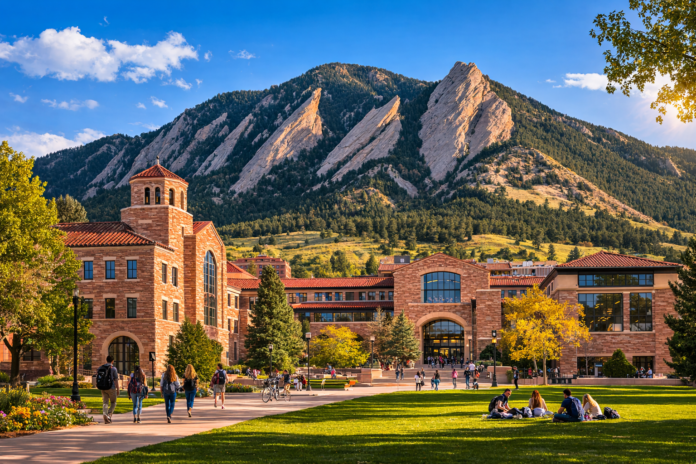
The University of Colorado Boulder represents one of America’s premier public research universities, delivering world-class education amid the stunning Rocky Mountain backdrop that defines its identity. For US high school students weighing college options, international applicants seeking STEM opportunities with OPT extensions, parents calculating long-term ROI and career-driven individuals prioritizing job placement, this comprehensive 2026 guide provides actionable data on admissions processes, top programs, exact costs financial aid pathways campus resources and graduate outcomes to support informed application decisions.
University Introduction
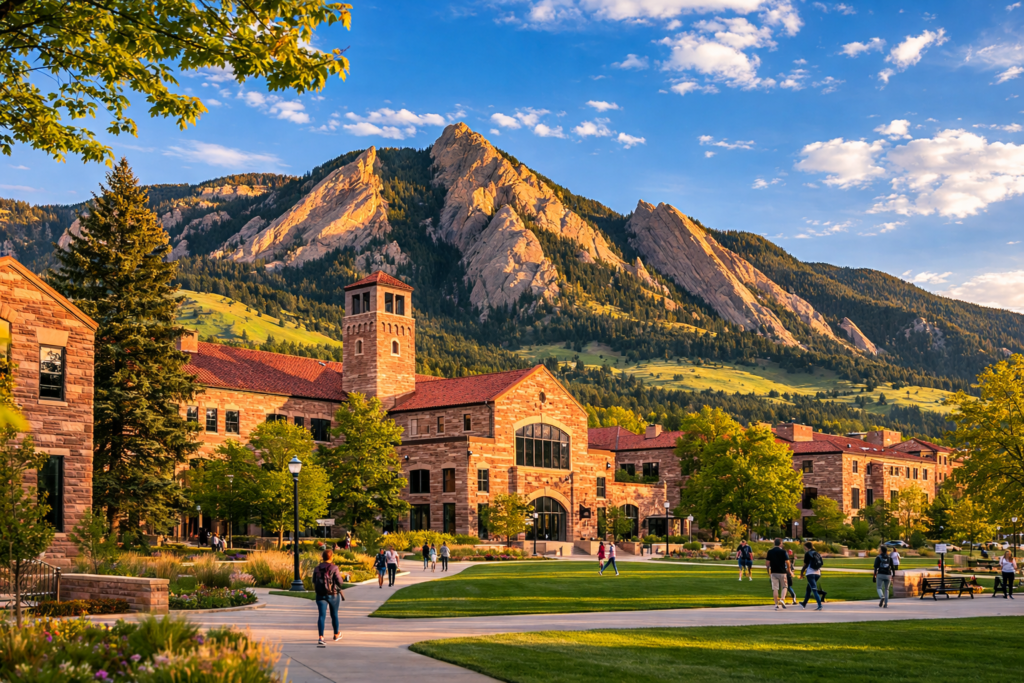
The University of Colorado Boulder functions as the flagship public institution within Colorado’s four-campus University of Colorado system, established by the state legislature in 1876 to advance higher education accessibility for residents while attracting talent nationwide and globally. Nestled in the dynamic city of Boulder, Colorado—approximately 30 miles northwest of Denver and directly at the base of the Flatirons rock formations this 600-acre campus creates an unparalleled learning environment where students balance rigorous academics with immediate access to world-class hiking skiing and climbing opportunities that enhance mental health and work life integration.
CU Boulder proudly holds the Carnegie Classification’s R1 designation, signifying very high research activity, with annual expenditures exceeding $634 million funneled into cutting-edge initiatives across aerospace engineering, atmospheric sciences, quantum information science, renewable energy technologies, and neuroscience. This research intensity translates directly to student benefits: over 8,000 undergraduates participate annually in paid research positions through programs like CURIE and the Grand Challenge Scholars, gaining publications, patents, and conference presentations that distinguish their resumes in competitive job markets. The university houses 22 specialized research institutes, including the prestigious Laboratory for Atmospheric and Space Physics (which has contributed to every NASA planetary mission since 1960) and the Renewable and Sustainable Energy Institute, positioning CU Boulder as a national leader in addressing climate change and technological innovation.
On the athletic front, CU Boulder’s Buffaloes teams compete at the highest level in NCAA Division I as full members of the Big 12 Conference, fielding 17 varsity sports that include football at the flagship Folsom Field (capacity 50,183), men’s and women’s basketball in the iconic CU Events Center championship caliber alpine and Nordic skiing programs, and track and field events that routinely qualify athletes for Olympic trials. This athletic prominence not only fosters intense school spirit manifested in traditions like the Ralphie the Buffalo run-out—but also builds leadership skills and networking opportunities through booster clubs and alumni events, making CU Boulder particularly appealing to students who value a holistic college experience blending intellectual pursuit with competitive energy.
Read also : University of Arizona Tuition Fees, Acceptance Rate, Admission, and Campus Life 2026
Why Choose University of Colorado Boulder
Selecting the University of Colorado Boulder from a distinctly American viewpoint centers on its exceptional return on investment where graduates consistently out-earn national averages due to strategic location, employer partnerships, and program quality that align with high-demand sectors fueling the US economy. In-state Colorado residents access one of the nation’s best public university values at approximately $13,500 annual tuition, while out-of-state students frequently offset the $42,000 non-resident rate through merit scholarships averaging $12,000, yielding a net cost comparable to many private institutions yet with superior research credentials and graduate outcomes.
Job placement data underscores this value: 92% of bachelor’s degree recipients secure employment or enroll in graduate school within six months of graduation, with early-career median salaries hovering at $68,000 and climbing to $120,000+ by mid-career—a trajectory that surpasses 70% of US public universities according to federal earnings datasets. This success stems from CU Boulder’s Career Services office, which orchestrates over 50 annual job fairs attended by 1,200+ employers, alongside college-specific pipelines like the Leeds School of Business’ 90% internship placement rate and the College of Engineering’s co-op programs embedding students at firms like Lockheed Martin and Google for academic credit and pay averaging $25/hour.
Campus reputation further amplifies appeal: CU Boulder consistently ranks among the top 100 national universities (often #98-105 in US News metrics), celebrated for undergraduate teaching quality, innovation (42 nationally), and best-value schools, while its Boulder location taps into a metro economy boasting 300,000+ tech and aerospace jobs within a one-hour drive. Parents planning for their child’s future appreciate the tuition guarantee locking rates for four years, shielding against inflation, and the robust alumni network of 350,000+ strong that spans Silicon Valley to Wall Street. For international students on F-1 visas, 40+ STEM-designated programs qualify for three-year OPT extensions, providing a critical bridge to H-1B sponsorships in America’s talent-short fields.
University of Colorado Boulder Popular Academic Programs
CU Boulder’s seven colleges and schools deliver over 270 undergraduate majors, certificates, and graduate degrees with a deliberate emphasis on experiential learning through capstone projects, industry-sponsored design challenges, and global study abroad options in 75 countries. Programs prioritize employability, integrating professional development seminars, mock interviews, and LinkedIn portfolio building from freshman year to ensure graduates hit the ground running in competitive US markets.

University of Colorado Boulder Undergraduate Programs
Undergraduate offerings emphasize flexibility with double majors common (30% of students pursue them) and minors in high-growth areas like data science or entrepreneurship available across disciplines.
| Program | Key Focus Areas | Typical Career Paths | Enrollment (Approx.) | Avg. Starting Salary |
|---|---|---|---|---|
| Computer Science (BS, College of Engineering) | Algorithms, machine learning, cloud computing, cybersecurity | Software developer, AI engineer, systems analyst | 1,800+ | $95,000 |
| Aerospace Engineering Sciences (BS) | Aerodynamics, propulsion, satellite systems, astrodynamics | Aerospace engineer, mission analyst at Boeing/NASA | 900+ | $88,000 |
| Mechanical Engineering (BS) | Thermodynamics, robotics, advanced manufacturing, biomechanics | Mechanical design engineer, R&D specialist | 1,400+ | $82,000 |
| Business Administration (Leeds School, BSBA) | Corporate finance, digital marketing, supply chain, real estate | Financial analyst, management consultant, startup founder | 2,500+ | $72,000 |
| Environmental Engineering (BS) | Water treatment, renewable energy systems, pollution control | Sustainability consultant, civil engineer at EPA firms | 500+ | $76,000 |
| Molecular, Cellular & Developmental Biology (BS) | Genomics, immunology, synthetic biology | Biotech researcher, pharmaceutical sales specialist | 700+ | $68,000 |
| Strategic Communication (BA) | Public relations, digital strategy, crisis communication | Media planner, corporate communicator at Edelman | 600+ | $65,000 |
These majors boast 85%+ internship rates, with partnerships ensuring placements at top firms before graduation.
University of Colorado Boulder Graduate Programs
Graduate pathways cater to career accelerators, with professional master’s designed for one-to-two-year completion and full-time PhDs offering stipends averaging $32,000 plus tuition waivers.
| Program | Duration | Key Outcomes | Avg. Salary Post-Grad | Funding Availability |
|---|---|---|---|---|
| MS in Computer Science | 1.5 years | Placements at Meta, NVIDIA; thesis or non-thesis tracks | $125,000 | 70% funded |
| MS in Aerospace Engineering Sciences | 2 years | LASP projects, SpaceX interviews | $112,000 | 80% assistantships |
| Full-Time MBA (Leeds) | 21 months | Global immersions, venture competitions | $135,000 | Scholarships for 60% |
| MS Electrical, Computer & Energy Engineering | 1.5–2 years | Power electronics, quantum hardware | $118,000 | Full funding common |
| MS Environmental Studies | 2 years | Policy analysis, corporate sustainability roles | $98,000 | Partial fellowships |
| PhD Physics (Quantum Focus) | 5–6 years | National lab positions, academia | $140,000+ | 100% stipends |
| MS Accounting (Leeds) | 1 year | Big Four audits, forensic accounting | $105,000 | Merit awards |
Graduate students access dedicated career treks to DC, Seattle tech hubs, and NYC finance centers.
How International Students Apply to University of Colorado Boulder
International students follow a structured application process designed to ensure academic readiness, English proficiency, and financial self-sufficiency for F-1 visa eligibility. Applications open August 1 via the Common App or CU Boulder portal, with Early Action deadline November 15 for priority merit consideration and I-20 processing.

Step-by-Step Application Process for International Students
- Research Programs and Deadlines: Identify STEM-designated majors for OPT advantages; note college-specific requirements (e.g., engineering portfolios).
- Submit Online Application: Common App ($70 fee) including CU supplements on leadership, diversity, and career goals.
- Academic Transcripts: Official secondary school records (equivalent to US diploma) with SpanTran or ECE credential evaluation showing US 3.0+ GPA equivalent.
- English Proficiency Tests: Submit one of: TOEFL iBT 90+ (writing/subscores 20+), IELTS Academic 6.5+ (no band <6.0), Duolingo 115+, or PTE 115. Waivers granted for 3+ years English-medium instruction.
- Optional but Recommended Tests: SAT 1275+ or ACT 29+ strengthens competitive applications, especially for scholarships.
- Financial Documentation: Post-acceptance, submit CSS Profile and bank certification demonstrating $80,000+ USD for first-year COA (tuition $42K + living $28K + insurance $2.5K + reserves $7K). Sponsor affidavits accepted from parents/guardians.
- Visa Process: Receive I-20, pay SEVIS $350 fee, schedule F-1 interview at US embassy (show ties to home country, funding proof).
- Health Requirements: TB test, immunization records (MMR, varicella); purchase CU health insurance unless comparable waiver approved.
Key Criteria and Funding Requirements
- Academic Threshold: 3.5+ GPA equivalent, rigorous STEM prep (calculus, physics, lab sciences).
- Minimum Funding Proof: $80,292 first year, $65,000 subsequent years (no aid dependency). Scholarships reduce this amount pro-rata.
- Competitive Profile: 95th percentile test scores, research/internships, strong essays on cross-cultural adaptation.
University of Colorado Boulder Most Common Countries of Origin for Students
CU Boulder enrolls 3,000+ internationals (8% of students) primarily from:
| Country | % of International Students | Popular Majors |
|---|---|---|
| China | 35% | Engineering, Computer Science |
| India | 20% | Computer Science, Business |
| South Korea | 10% | Aerospace, Physics |
| Saudi Arabia | 8% | Engineering (government-sponsored) |
| Iran | 5% | Electrical Engineering |
| Canada | 4% | Environmental Sciences |
| Brazil | 3% | Business, Media |
| Germany | 3% | Physics, Renewable Energy |
| Japan | 3% | Computer Science |
| Vietnam | 2% | Business Administration |
Chinese and Indian students dominate STEM fields due to scholarship pipelines and OPT pathways; Middle Eastern sponsorships fund full rides.
University of Colorado Boulder Admission Requirements
CU Boulder’s 2026 admissions employ a holistic, committee-based review process prioritizing academic preparation, intellectual vitality, and contributions to campus community, with an overall acceptance rate of 78% but program-specific rates dipping to 50% for engineering and business. Applications open August 1 via Common App or CU Boulder portal, with Early Action (non-binding) by November 15 guaranteeing priority scholarships and housing.
University of Colorado Boulder Admission Requirements for US Students
First-year domestic applicants emphasize high school course rigor (e.g., 4+ years math/science).
- GPA: Admitted average 3.68 unweighted (3.90 weighted); top 25% class rank preferred.
- Standardized Tests: Test-optional policy continues; middle 50% SAT 1275–1440 (Math 620–720, EBRW 630–720), ACT 29–33.
- Application Components: 650-word Common App essay, four CU-specific supplements (250 words each on diversity, leadership, career goals, academic interest), one counselor recommendation, optional arts portfolio.
- Transfer Applicants: Minimum 24 semester credits, 3.20+ GPA; major-specific prerequisites (e.g., calculus for STEM); credit evaluation via Transferology tool.
Guaranteed admission pathways exist for Colorado community college honors students completing 60 credits with 3.0 GPA.
University of Colorado Boulder Admission Requirements for International Students
Global applicants mirror domestic requirements with visa-supporting documentation (detailed in dedicated section above).
- Credential Evaluation: Required via SpanTran or ECE for secondary/post-secondary transcripts.
- English Proficiency: TOEFL iBT 90 minimum (no section <20, writing emphasized), IELTS 6.5 overall (no band below 6.0), PTE 115, or Duolingo 115; waivers for English-medium instruction.
- Financial Certification: $80,000+ bank statement or sponsor affidavit for I-20 issuance; post-acceptance only.
- Additional: SAT/ACT recommended for competitive majors; interviews optional via alumni volunteers.
Job-focused internationals strengthen applications with prior internships or research; F-1 visa interview prep provided post-admission.
University of Colorado Boulder Tuition Fees, Living Cost and Total Cost of Attendance
2025–2026 costs incorporate a four-year tuition lock for undergraduates, stabilizing budgets amid inflation; total cost of attendance (COA) factors direct (billed) and indirect expenses. In-state benefits from Colorado Forward funding model reduce rates 65% below out-of-state.
| Category | In-State (USD/Year) | Out-of-State (USD/Year) | International (USD/Year) | Notes |
|---|---|---|---|---|
| Tuition & Mandatory Fees | $13,482–$14,968 | $41,943–$45,392 | $41,943–$45,392 + $500 one-time | Engineering/business higher by $2K |
| On-Campus Housing | $8,000–$11,000 | $8,000–$11,000 | $8,000–$11,000 | Double room baseline |
| Dining/Meal Plan | $6,200–$8,500 | $6,200–$8,500 | $6,200–$8,500 | Unlimited plan standard |
| Books, Course Materials, Supplies | $1,200–$1,600 | $1,200–$1,600 | $1,200–$1,600 | Digital options reduce costs |
| Personal Expenses & Transportation | $4,200–$5,400 | $4,200–$5,400 | $4,200–$5,400 | Includes bike maintenance |
| Health Insurance | $2,500 (waivable with comparable plan) | $2,500 (waivable) | $2,500 (mandatory unless waived) | CU Student Plan comprehensive |
| Total Estimated COA | $37,584–$43,968 | $65,045–$73,792 | $65,545–$74,292 | 9-month academic year |
Net price calculator projects personalized costs; 55% pay under $20K after aid.
University of Colorado Boulder Scholarships and Financial Aid Options
Aid reaches 92% of undergraduates (average $26,500 package); US students file FAFSA by February 1, CSS Profile for select scholarships. Internationals compete for merit-only awards.
| Scholarship Type | Eligibility Criteria | Award Amount (USD/Year) | Renewal Terms | Application Process |
|---|---|---|---|---|
| Chancellor’s Achievement Scholarship | Non-residents; 3.80+ GPA, 1400+ SAT/33+ ACT | $10,000–$17,000 | 4 years, 3.0 GPA | Auto-consider with admission app |
| President’s Scholars Program (In-State) | Colorado residents, top 5% class, leadership | Full in-state tuition + stipend | 4 years, 3.2 GPA | Nominee-based, separate app |
| International First-Year Merit | 3.90+ GPA, TOEFL 100+, extracurriculars | $5,000–$15,000 | 4 years, 3.25 GPA | Auto-award post-admission |
| College-Specific (e.g., Engineering Dean’s) | Major admits, 3.75+ GPA | $8,000–$20,000 | GPA maintained | Department review |
| Need-Based Buffs Grant | FAFSA EFC <$15K, Colorado resident priority | $4,000–$14,000 | Annual FAFSA | Auto via FAFSA |
| Federal Pell Grant | US citizens, EFC <$7,395 eligibility | Up to $7,395 | Annual | FAFSA only |
| Leeds Business Scholarships | BSBA admits, GMAT/GRE optional | $10,000–$25,000 | 3.3 GPA | Separate Leeds app |
| Work-Study/On-Campus Jobs | Need-eligible US students | $3,000–$6,000 earnings | Annual | FAFSA + Handshake app |
Layering aid (grant + scholarship + job) often covers 70% COA; private loans at 5.5–8% for gaps.
University of Colorado Boulder Campus Life and Student Facilities
CU Boulder’s campus pulses with energy across 450+ registered student organizations, from the entrepreneurial Buff Startup Weekend to cultural groups like the Indian Students Association and Black Student Alliance, ensuring inclusivity for US and international communities. Sustainability leadership shines: #2 nationally for green power, zero-waste events, and a bike share program logging 100,000+ rides yearly.
Academic facilities impress with the Norlin Library (3.2 million volumes, 24/7 study spaces), Center for Community Faculty’s makerspaces equipped with 3D printers and CNC machines, and college-specific labs like the ATLAS Institute’s human-centered computing playground. Recreation thrives at three facilities—the Student Recreation Center (Olympic pool, bouldering gym), CU Fitness Center, and outdoor Adventure Program offering guided climbs and rafting—used by 80% of students weekly.
Dining sustains 40,000 meals daily across 30 venues emphasizing farm-to-table sourcing, with certified vegan stations, halal/kosher options, and allergy-friendly protocols. Health services encompass free counseling via Counseling and Psychiatric Services (CAPS, 20-session limit), Wardenburg Health Center’s primary care and STI clinics, and 24/7 crisis support. International Office provides visa workshops, tax filing assistance, and welcome orientations; accessibility ramps and service animals support diverse needs.

Read also : Risk Analyst Jobs in 2026: The Ultimate Guide to US Laws, Sanctions, and Career Success
University of Colorado Boulder Career Outcomes and Internship Opportunities
CU Boulder’s Career Services delivers personalized coaching, resume critiques, and Handshake portal access to 500,000+ jobs/internships, culminating in 92% placement success. Undergrads average two internships; grads leverage outcomes dashboards tracking alumni by major.
| Metric | Undergraduate | Graduate |
|---|---|---|
| 6-Month Placement Rate | 92% (employed/grad school/enlisted) | 96% |
| Median Starting Salary | $68,400 | $108,500 |
| Top Industries | Technology (32%), Engineering (24%), Business/Finance (19%) | Aerospace/Defense (28%), Tech (26%), Consulting (18%) |
| Top Recruiters | Google, Lockheed Martin, Deloitte, Ball Aerospace, IBM, Raytheon, PwC | Boeing, Microsoft, KPMG, Northrop Grumman, startups |
| ROI Payback Period | 4.2 years (post-aid net cost) | 3.1 years |
STEM fields hit $85K+ starts; business $72K. 75% of interns convert to full-time offers.

Comparison Table: University of Colorado Boulder vs. Arizona State University vs. Pennsylvania State University
| Factor | University of Colorado Boulder | Arizona State University (ASU) | Pennsylvania State University | Premium Explanation |
|---|---|---|---|---|
| Annual Tuition (Out-of-State Undergraduate) | $42,000 | $32,100 | $39,600 | ASU remains lowest-cost for out-of-state students, while CU Boulder and Penn State demand higher investment for stronger long-term return. |
| Admission Selectivity | 78% acceptance | 88% acceptance | 55% acceptance | Penn State is clearly more selective, making admission comparatively harder than Boulder and ASU. |
| Average First-Year Graduate Salary | $68,400 | $55,200 | $64,100 | CU Boulder leads salary outcomes, especially in engineering, aerospace, and computer science careers. |
| Research Investment (Annual) | $634M (R1) | $260M (R1) | $1B+ (R1) | Penn State dominates total research funding and attracts major federal and industry projects. |
| Regional Employment Advantage | Boulder–Denver tech/aerospace corridor | Phoenix growth economy | Northeast finance, manufacturing, engineering belt | Boulder offers premium tech hiring access, while Penn State benefits from powerful East Coast employer networks. |
| Internship Success Rate | 85% | 78% | 84% | CU Boulder slightly leads because of strong direct employer partnerships before graduation. |
| STEM OPT Eligible Programs | 42 | 35 | 40+ | More STEM options directly improve post-study work opportunities for international students. |
| National Academic Ranking | #98 | #121 | #60 | Penn State has stronger national academic visibility and brand value among employers. |
| Best Fit for Students | Career-focused STEM/business students | Budget-conscious high-volume applicants | Prestige-focused students seeking alumni power | Choice depends on whether student values lower cost, higher salary, or stronger university brand. |
| Residence Hall Cost (9 Months) | $16,062–$19,514 | Lower average | $13,000–$15,500 | Boulder housing remains expensive because of local rental demand and limited supply. |
| Campus Apartment Cost | $14,500–$17,800 | Moderate | Moderate | Penn State and ASU provide more affordable apartment choices than Boulder. |
| Shared Off-Campus Rent | $12,000–$18,000 | Lower | Moderate | Boulder off-campus rent is among the highest due to city demand and limited student housing. |
| Private Studio Cost | $20,000–$25,000 | Lower | Lower | Independent living costs in Boulder remain significantly above most public university markets. |
| Monthly Utility Expense | $150–250 | Lower | Lower | Utility costs remain manageable but must always be added separately to living budgets. |
| Part-Time Earnings Potential | $16–18/hour | Similar | Similar | Student hourly wages are similar, but Boulder often offers higher-paying technical campus jobs. |
| International Work Limit | 20 hrs/week | 20 hrs/week | 20 hrs/week | Federal visa employment rules remain identical across all three universities. |
Read also : University of Pennsylvania Tuition Fees, Acceptance Rate, Admission, and Campus Life 2026
University of Colorado Boulder Housing and Living Costs
Freshmen receive housing priority; 85% live on-campus year one. Boulder COL index 125% national average necessitates budgeting.
| Housing Option | Annual Cost (USD, 9 Months) | Amenities | Availability |
|---|---|---|---|
| Residence Halls (Double) | $16,062–$19,514 | Shared bath, meal plan, learning communities | Guaranteed freshmen |
| Suites/Apartments (Campus) | $14,500–$17,800 | Private bath, kitchenette, study lounges | Lottery system |
| Off-Campus Shared (4-Bed) | $12,000–$18,000 | Flexible lease, laundry in-unit | Craigslist/Handshake |
| Private Off-Campus Studio | $20,000–$25,000 | Independence, parking | Competitive market |
Utilities $150–250/month extra; part-time jobs (tutoring $18/hr, barista $16/hr) cover 40% costs. Internationals limited to 20 on-campus hours/week.

Final Verdict: Who Should Apply & Who Should Avoid
Target CU Boulder if you’re a high-achieving US student from Colorado or neighboring states leveraging in-state affordability and merit aid, an international F-1 visa holder pursuing STEM OPT in tech/aerospace amid Denver’s 350K jobs (with $80K funding secured), a parent modeling 4-year ROI at $250K lifetime earnings premium, or job-focused applicant ready to intern aggressively for $70K+ launches. Finance reality: Post-$25K aid, net $40K/year yields payback by age 26 at median salaries, outpacing 80% peers.
Steer clear if family income caps aid eligibility below $50K/year without loans, you demand small seminars (student-faculty ratio 18:1 averages 40/person classes), or prefer urban anonymity over outdoorsy camaraderie—consider in-state community colleges transferring to CSU or urban publics like ASU. Passive networkers risk average outcomes; proactive hustlers thrive.
Read also : How Much Does It Cost to Live in Fayetteville Arkansas in 2026? Full Breakdown
Frequently Asked Questions (FAQ)
- What GPA do I need for University of Colorado Boulder admission?
- Admitted freshmen average 3.68 unweighted GPA; holistic review values AP/IB rigor over raw numbers.
- Is the SAT or ACT required for University of Colorado Boulder 2026?
- Fully test-optional; submit scores above 1300 SAT/30 ACT to strengthen competitive majors like engineering.
- How much does University of Colorado Boulder cost for international students?
- Total COA $66,000–$74,000/year; merit scholarships reduce to $55K net for top applicants.
- What scholarships does University of Colorado Boulder provide for internationals?
- Merit awards $5K–$15K based on academics; no need-based, require $80K financial proof for I-20.
- What is the University of Colorado Boulder acceptance rate for 2026?
- Overall 78%, with Early Action improving odds by 10–15% for scholarships/housing.
- What average salary do University of Colorado Boulder graduates earn?
- Undergrads $68,400 starting, $120K mid-career; STEM/business exceed $85K entry.
- Are University of Colorado Boulder dorms good for freshmen?
- Excellent modern suites with AC, elevators, communities; 80% freshmen participate, easing transition.
- What is the University of Colorado Boulder TOEFL/IELTS requirement?
- TOEFL iBT 90+ (writing 20+), IELTS 6.5 (no subscore <6.0); Duolingo 115 accepted.

