

Introduction: Why Cloud Engineering Is the Hottest Career in the USA Right Now
The cloud computing industry in the United States is growing at an unprecedented pace. With businesses of every size from Fortune 500 giants like Amazon, Microsoft, and Google to fast-growing startups moving their entire infrastructure to the cloud, the demand for skilled cloud engineers has never been higher. In fact, cloud computing is now one of the top three most in-demand technology skills across every major US employer in 2026.
Whether you are a recent computer science graduate, an IT professional looking to switch into a higher-paying specialization, or an international student exploring career paths in the United States on an OPT or work visa, a career as a cloud engineer offers exceptional earning potential, remote work flexibility, and long-term job security that very few other technology roles can match.
In this comprehensive guide, you will learn exactly what a cloud engineer does, how much cloud engineers earn in the USA, which cloud engineering jobs are in highest demand right now, what skills and certifications you need to land your first cloud engineering position, and the step-by-step path to becoming a cloud computing engineer whether you are starting from scratch or transitioning from an existing IT role.
This guide is designed for everyone from US citizens and permanent residents to international students and H-1B visa holders who wants to break into one of the most lucrative technology careers available in the American job market today.
What Is a Cloud Engineer? Role, Responsibilities & Types
A cloud engineer is a technology professional who designs, builds, maintains, and optimizes cloud-based infrastructure and services for organizations. Cloud engineers work with platforms like Amazon Web Services (AWS), Microsoft Azure, and Google Cloud Platform (GCP) to deploy applications, manage databases, automate processes, and ensure that systems run securely, reliably, and at scale.
Unlike traditional IT professionals who manage physical servers and on-premise hardware, cloud engineers work entirely in virtual environments which is exactly why demand for them has skyrocketed as businesses have moved away from on-premise infrastructure toward cloud-based solutions. In fact, this shift is so significant that even large legacy companies like Thomson Reuters are actively moving away from on-premise storage toward cloud infrastructure, creating thousands of new cloud engineer positions every year.
There are three main types of cloud engineer positions, and understanding the differences is important before you decide which cloud engineering career path to pursue:

- Cloud Solutions Architect: Designs the overall cloud infrastructure and strategy for an organization. This is typically a senior-level cloud engineering position requiring 5+ years of experience.
- Cloud DevOps Engineer: Focuses on the automation, deployment, and continuous integration and delivery (CI/CD) pipelines that allow software to be deployed to the cloud quickly and reliably.
- Cloud Security Engineer: Specializes in securing cloud environments, managing identity and access management (IAM), and ensuring compliance with regulations like SOC 2, HIPAA, and FedRAMP.
- Cloud Data Engineer: Focuses on building and managing data pipelines, data warehouses, and analytics infrastructure in cloud environments — one of the fastest-growing cloud engineering specializations.
- Cloud Support Engineer: Provides technical assistance to organizations using cloud platforms, troubleshooting issues and helping teams optimize their cloud usage. This is often the best entry-level cloud engineer position for beginners.
Cloud Engineer Role Comparison — USA 2026
| Cloud Role | Experience Needed | Avg USA Salary | Top Skills Required | Demand Level |
| Cloud Solutions Architect | 5–8+ years | $140K–$180K/yr | AWS/Azure/GCP, Terraform | Very High |
| Cloud DevOps Engineer | 3–6 years | $120K–$160K/yr | CI/CD, Docker, Kubernetes | Extremely High |
| Cloud Security Engineer | 4–7 years | $130K–$175K/yr | IAM, SOC 2, CISSP | High |
| Cloud Data Engineer | 2–5 years | $110K–$150K/yr | Spark, Snowflake, BigQuery | Very High |
| Cloud Support Engineer | 0–2 years | $70K–$100K/yr | AWS basics, Linux, tickets | High (Entry Level) |
Read Also :Risk Analyst Jobs in 2026: The Ultimate Guide to US Laws, Sanctions, and Career Success
Cloud Engineer Salary in the USA: How Much Do Cloud Engineers Make in 2026?
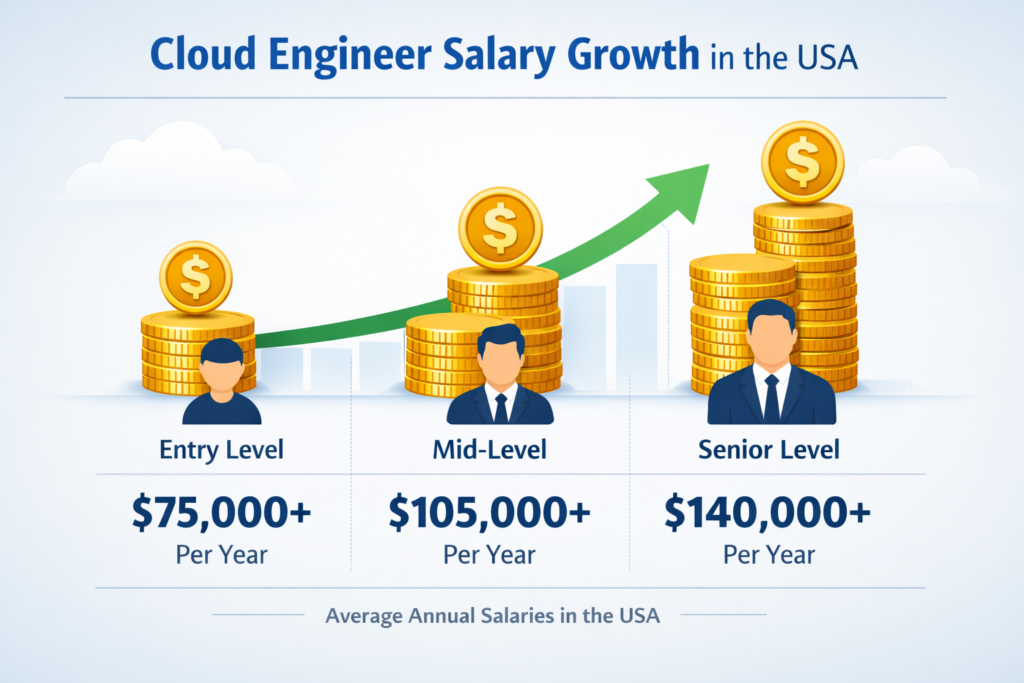
One of the most frequently asked questions about cloud engineering careers is: how much does a cloud engineer actually make in the United States? The answer is extremely encouraging cloud engineers are among the highest-paid technology professionals in the entire US job market, with compensation packages that often exceed six figures even at the entry level.
According to current market data from Glassdoor, LinkedIn Salary, and Levels.fyi, here is a detailed breakdown of cloud engineer salaries across different experience levels and top US cities in 2026:
| Experience Level | National Avg | San Francisco, CA | New York, NY | Austin, TX / Remote |
| Entry Level (0–2 yrs) | $85,000–$105,000 | $110,000–$135,000 | $100,000–$125,000 | $80,000–$100,000 |
| Mid Level (3–5 yrs) | $115,000–$140,000 | $150,000–$185,000 | $135,000–$165,000 | $110,000–$138,000 |
| Senior (6–9 yrs) | $150,000–$185,000 | $195,000–$240,000 | $175,000–$215,000 | $145,000–$180,000 |
| Cloud Architect (10+ yrs) | $180,000–$220,000 | $240,000–$300,000+ | $210,000–$260,000 | $170,000–$210,000 |
| Cloud Engineering Manager | $190,000–$250,000 | $260,000–$350,000+ | $235,000–$290,000 | $180,000–$230,000 |
Salary Insight: These figures represent base salary only. Total compensation packages for cloud engineers at top US tech companies like Google, Amazon, and Microsoft often include stock options, annual bonuses, and benefits that can add $30,000–$100,000+ per year to the total package. Cloud engineers with specialized certifications in AWS, Azure, or GCP typically command 15–25% higher salaries than those without certifications.
The cloud engineering salary premium is also one of the strongest arguments for international students and work visa holders to target this career path. Not only does the high salary justify the cost of education and visa fees, but cloud engineering employers are among the most active H-1B sponsors in the United States — making it one of the best career paths for long-term immigration goals as well.
Read Also : The Complete Guide to Sanctions Analyst Jobs in USA 2026: OFAC, AML, KYC, CTR, Laws, Salary & Career Path
Cloud Engineer Jobs in the USA: Where to Find the Best Cloud Engineering Positions in 2026
The cloud engineer job market in the United States is extraordinarily active in 2026. With the global cloud computing market projected to exceed $900 billion by 2027, American companies are hiring cloud engineers at a pace that significantly outstrips the available talent pool — which means experienced and even entry-level cloud engineers are in an incredibly strong negotiating position when it comes to salary, benefits, and remote work arrangements.
Here are the best places to find cloud engineer jobs in the USA, based on current hiring activity and placement success rates:
- LinkedIn Jobs: The number one platform for cloud engineer positions in the USA. Use filters for ‘Cloud Engineer,’ ‘Cloud DevOps,’ and ‘Cloud Architect.’ Set up job alerts for your target role and location.
- Dice.com: The most specialized technology job board in the United States. Dice consistently lists thousands of active cloud engineering positions and allows you to filter by sponsorship status — critical for international candidates.
- AWS Jobs (jobs.amazon.com): Amazon Web Services is the world’s largest cloud platform and one of the biggest employers of cloud engineers in the USA. Applying directly through AWS careers gives you access to positions not listed on general job boards.
- Microsoft Careers: Microsoft Azure is the second-largest cloud platform globally. Microsoft actively recruits cloud engineers and is one of the top H-1B sponsors in the technology sector.
- Google Careers: Google Cloud Platform (GCP) is the third major cloud provider. Google hires cloud engineers at all experience levels and offers some of the highest total compensation packages in the industry.
- Indeed and Google Jobs: Aggregate job boards that pull cloud engineering positions from thousands of employer websites simultaneously. Use these for high-volume applications.
- Wellfound (AngelList): The best platform for cloud engineer jobs at startups and growth-stage technology companies — often offering equity compensation on top of competitive salaries.
Top USA Companies Hiring Cloud Engineers in 2026 — H-1B Sponsor Status Included
| Company | Cloud Platform | Avg Cloud Eng Salary | H-1B Sponsor | Best Role to Target |
| Amazon (AWS) | AWS | $145K–$195K | Yes (Top Sponsor) | Cloud Support / SDE |
| Microsoft (Azure) | Azure | $155K–$210K | Yes (Top Sponsor) | Cloud Solutions Eng. |
| Google (GCP) | GCP | $175K–$250K+ | Yes (Top Sponsor) | Cloud Architect / SRE |
| IBM | IBM Cloud / AWS | $110K–$155K | Yes | Cloud DevOps Eng. |
| Accenture | Multi-cloud | $105K–$145K | Yes (Active) | Cloud Consultant |
| Deloitte | Multi-cloud | $115K–$155K | Yes (Active) | Cloud Security Eng. |
| Tesla | AWS / Custom | $130K–$175K | Yes | Cloud Data Eng. |
Read Also : Forklift Operator Jobs in USA 2026: High Paying Career Guide, Salary, Visa & Future Trends
Cloud Engineer Skills & Certifications: What You Need to Get Hired in 2026
Landing a cloud engineer position whether it is an entry-level cloud support role or a senior cloud solutions architect position — requires a specific combination of technical skills, hands-on project experience, and recognized industry certifications. Here is a complete breakdown of what US employers are looking for in cloud engineering candidates in 2026:
Core Technical Skills Every Cloud Engineer Must Have
- Cloud platform proficiency: Deep knowledge of at least one major platform AWS, Microsoft Azure, or Google Cloud Platform. AWS is the most widely used cloud platform in the USA and knowing it gives you access to the largest pool of cloud engineer job openings.
- Infrastructure as Code (IaC): Terraform and AWS CloudFormation are the two dominant IaC tools used by US cloud engineering teams. Proficiency in at least one is expected for any mid-to-senior cloud engineering position.
- Containerization and orchestration: Docker and Kubernetes are now standard requirements for cloud DevOps and cloud computing engineer roles across the US job market.
- Linux/Unix systems administration: The vast majority of cloud infrastructure runs on Linux. Strong Linux command-line skills are non-negotiable for any cloud engineering role.
- Networking fundamentals: Understanding of TCP/IP, VPCs, subnets, load balancers, DNS, and firewalls is essential for any cloud engineer working with production infrastructure.
- Scripting and automation: Python and Bash scripting are the most commonly required programming skills for cloud engineers in the USA.
- CI/CD pipelines: Familiarity with Jenkins, GitHub Actions, GitLab CI, or AWS CodePipeline is expected for cloud DevOps engineer positions.
Top Cloud Engineering Certifications That USA Employers Value Most

- AWS Certified Solutions Architect – Associate: The single most recognized and valued cloud certification in the US job market. Earning this certification can increase your cloud engineer salary by 15–20%.
- AWS Certified DevOps Engineer – Professional: The top certification for cloud DevOps engineer positions. Highly valued at enterprise companies.
- Microsoft Azure Administrator (AZ-104): The most recognized Azure certification for cloud computing engineer roles at companies running on Microsoft infrastructure.
- Google Cloud Professional Cloud Architect: Google’s flagship certification, highly valued at companies using GCP and at consulting firms.
- HashiCorp Certified: Terraform Associate: The standard certification for Infrastructure as Code expertise — increasingly required by large US employers.
- Certified Kubernetes Administrator (CKA): Essential for cloud DevOps and platform engineering roles that involve container orchestration at scale.
Read Also : Solar Panel Installer Jobs in USA (2026) — Salary Companies & Hiring Cities
How to Become a Cloud Engineer in the USA: Step-by-Step Roadmap (2026)
Whether you are a computer science student, a self-taught developer, or an IT professional looking to transition into cloud engineering, the path to becoming a cloud engineer in the United States in 2026 is more accessible than ever. Here is the exact step-by-step roadmap you should follow:
- Step 1 — Learn the fundamentals of cloud computing: Start with free resources like AWS Skill Builder, Microsoft Learn, and Google Cloud’s free training platform. Understand what cloud computing is, the difference between IaaS, PaaS, and SaaS, and the basics of virtual machines, storage, and networking in the cloud.
- Step 2 — Choose your primary cloud platform: For US job seekers, AWS is the safest choice because it has the largest market share and the most job openings. If you are targeting Microsoft-heavy enterprise environments, Azure is the better choice. If you want to work at data-driven or AI-focused companies, GCP is excellent.
- Step 3 — Get your first certification: Aim for the AWS Certified Cloud Practitioner or AWS Solutions Architect Associate within your first 3 months of study. Use resources like A Cloud Guru, Adrian Cantrill’s course, or the official AWS training portal.
- Step 4 — Build hands-on projects: Create a free tier AWS account and build real projects deploy a static website on S3, set up a serverless function with Lambda, build a CI/CD pipeline with CodePipeline, or host a containerized application on ECS. Employers value hands-on experience above everything else.
- Step 5 — Learn Python and Terraform: These are the two most important secondary skills for cloud engineers in the USA. Even basic proficiency in both significantly increases your hirability and salary potential.
- Step 6 — Build your cloud engineering portfolio on GitHub: Document your cloud projects with clear READMEs, architecture diagrams, and cost estimates. A strong GitHub portfolio can compensate for limited professional experience when applying for entry-level cloud engineer positions.
- Step 7 — Apply strategically for cloud engineer jobs: Start with cloud support engineer and junior cloud computing engineer roles to get your first industry experience. These entry-level positions typically require only 0–2 years of experience and are the most accessible entry points into a cloud engineering career.
Read Also : Plumber Salary in the USA (2026): Highest & Lowest Paying States, Hiring Companies, Visa Reality
Cloud Engineer Jobs for International Students in the USA: OPT, H-1B & Sponsorship Guide
For international students studying in the United States, cloud engineering is one of the absolute best career paths to pursue. Here is why: cloud engineering falls squarely within STEM (Science, Technology, Engineering, and Mathematics) degree categories — which means F-1 visa holders with computer science, information technology, electrical engineering, or related degrees are eligible for up to 36 months of OPT work authorization after graduation.
This extended OPT period gives international cloud engineering students three full years to work in the USA, gain practical experience, and secure H-1B visa sponsorship from an employer which is critical for long-term career and immigration goals. And because cloud engineering is one of the most in-demand specializations, US employers are far more willing to sponsor H-1B visas for cloud engineers than for generalist IT or business roles.

| Stage | Timeline | Key Action | Authorization Needed | Goal |
| During Studies | Year 1–3 of degree | Get AWS certification + build projects | None / On-campus work | Build skills & portfolio |
| Final Semester | 90 days before grad | Apply for OPT EAD card | F-1 OPT application via DSO | Get work authorization |
| OPT Year 1 | Months 1–12 | Land cloud engineer job | OPT EAD card (F-1) | US work experience |
| STEM OPT Extension | Months 12–36 | Apply for STEM OPT extension | E-Verify employer required | 2 more years to work |
| H-1B Sponsorship | Year 2–3 of OPT | Employer files H-1B petition | Annual H-1B lottery | Long-term US work rights |
OPT Strategy for Cloud Engineers: Target E-Verify registered employers from day one of your job search. All STEM OPT employers are legally required to be E-Verify participants. You can filter by E-Verify status on Dice.com and Indeed. AWS, Microsoft, Google, IBM, Accenture, and Deloitte are all E-Verify registered and among the most active STEM OPT and H-1B sponsors in the US tech industry.
Final Verdict: Is Cloud Engineering the Right Career for You in 2026?
After reviewing everything — the role, the salary data, the job market, the certification paths, and the immigration pathways for international students — the verdict is clear: cloud engineering is one of the single best career investments you can make in the United States in 2026, regardless of where you are starting from.
For US citizens and permanent residents, cloud engineering offers six-figure salaries within 2–3 years of entry, strong remote work options, and long-term job security in a market where demand consistently outpaces supply. The combination of high base salary, equity compensation at top tech companies, and low risk of automation makes cloud engineering one of the most resilient technology careers you can choose.
For international students and work visa holders, cloud engineering is arguably the single most strategic career path available in the USA. The STEM OPT extension gives you 36 months of work authorization after graduation, cloud employers are among the most active H-1B sponsors in the entire US tech industry, and the six-figure salary justifies every dollar spent on education and certification preparation.
The barrier to entry is lower than most people think. You do not need a specialized cloud engineering degree — many successful cloud engineers in the USA have computer science, information technology, electrical engineering, or even self-taught backgrounds. What matters is your certification portfolio, your hands-on project experience, and your ability to demonstrate real cloud skills to a hiring manager.
| Candidate Type | Best Entry Point | Fastest Cert Path | Realistic Timeline | Expected Salary (Yr 1) |
| CS Graduate (US) | Cloud Support Eng. | AWS SAA + CCP | 3–6 months to hire | $85K–$105K |
| IT Professional (Career Switch) | Cloud DevOps Eng. | AWS SAA + Terraform | 6–12 months | $100K–$130K |
| International Student (F-1 OPT) | Cloud Eng. Intern → Full-time | AWS CCP → SAA → DevOps | Start 90 days before grad | $85K–$115K |
| Self-Taught Beginner | Cloud Support Eng. | AWS CCP first | 9–18 months | $70K–$90K |
| Senior Dev (Upskilling) | Cloud Architect role | AWS SAP + Terraform | 3–6 months | $145K–$180K |
Start today. Create your free AWS account. Enroll in a structured certification course. Build one real cloud project this week. The cloud engineer career path is well-defined, the demand is undeniable, and the rewards — financial and professional — are among the best available in the entire US technology industry in 2026.
Read Also : Customer Service Representative Jobs in USA: The 2026 High-Paying Guide
Frequently Asked Questions (FAQ) — Cloud Engineer Career in the USA
Q1. What is a cloud engineer and what does a cloud engineer do on a daily basis?
A cloud engineer is a technology professional responsible for designing, deploying, and managing cloud-based infrastructure and services. On a typical day, a cloud engineer might provision new virtual machines and storage resources on AWS or Azure, write Terraform code to automate infrastructure deployments, monitor cloud system performance and costs using tools like CloudWatch or Azure Monitor, troubleshoot outages or performance issues in production environments, review and improve security configurations, or collaborate with software development teams to support application deployments through CI/CD pipelines. The exact daily responsibilities depend on the specialization cloud DevOps engineers focus more on automation and deployments, while cloud architects focus on system design and strategy.
Q2. How much does a cloud engineer make in the USA in 2026?
Cloud engineer salaries in the United States in 2026 range from approximately $85,000 per year for entry-level cloud support engineers to over $250,000 per year for senior cloud architects at top technology companies. The national average salary for a mid-level cloud engineer with 3–5 years of experience is approximately $120,000–$140,000 per year in base salary. Total compensation packages — including stock options, annual bonuses, and benefits — can add $20,000–$100,000+ to these figures at companies like Google, Amazon, and Microsoft. Cloud engineers with AWS, Azure, or GCP certifications consistently earn 15–25% more than uncertified peers at the same experience level.
Q3. How do I become a cloud engineer with no experience?
The fastest path to becoming a cloud engineer with no prior experience in 2026 is: first, learn cloud fundamentals using free resources from AWS Skill Builder or Microsoft Learn; second, earn the AWS Certified Cloud Practitioner certification (approximately 2–4 weeks of study); third, complete the AWS Certified Solutions Architect Associate exam (4–8 weeks of additional study); fourth, build 3–5 hands-on cloud projects on a free tier account and post them to GitHub; fifth, apply for cloud support engineer or junior cloud computing engineer positions on Dice.com and LinkedIn. Many successful cloud engineers in the US have entered the field through this certification-and-portfolio pathway without a specialized cloud engineering degree.
Q4. What is cloud engineering and how is it different from software engineering?
Cloud engineering is the discipline focused on designing, building, and managing the infrastructure and platforms that run in cloud environments — such as AWS, Microsoft Azure, and Google Cloud Platform. Software engineering, by contrast, focuses on writing application code that runs on top of that infrastructure. While there is significant overlap between the two disciplines — especially in roles like cloud DevOps engineer or cloud platform engineer — cloud engineers primarily work with infrastructure, networking, security, automation, and platform services rather than with application logic and programming. In 2026, many US technology companies hire for roles that blend both disciplines, commonly called ‘platform engineer’ or ‘infrastructure engineer’ positions.
Q5. Which cloud certification is best for getting a cloud engineer job in the USA?
For the US job market in 2026, the AWS Certified Solutions Architect Associate (SAA-C03) is consistently ranked as the single most valuable cloud certification for getting hired as a cloud engineer. It is recognized by virtually every US employer, validates foundational to intermediate cloud architecture knowledge, and is frequently listed as a requirement or preference in cloud engineer job descriptions. For cloud DevOps engineer roles, the AWS Certified DevOps Engineer Professional certification is the gold standard. For candidates targeting Microsoft Azure environments, the AZ-104 Azure Administrator certification is the most employer-recognized credential.
Q6. Can international students find cloud engineer jobs in the USA on OPT?
Yes — international students on F-1 OPT authorization can absolutely find cloud engineer jobs in the United States, and cloud engineering is actually one of the most OPT-friendly career fields available. Because cloud engineering is a STEM field, F-1 graduates are eligible for 12 months of standard OPT plus an additional 24 months of STEM OPT extension — giving them up to 36 months of work authorization. The most important requirement for STEM OPT is that the employer must be E-Verify registered. Major cloud engineering employers including Amazon, Microsoft, Google, IBM, and Accenture are all E-Verify registered and among the most active STEM OPT and H-1B sponsors in the US technology sector.
Q7. What is the cloud engineer position like at top tech companies compared to startups?
Cloud engineer positions at large US technology companies like Amazon, Microsoft, and Google offer the highest total compensation — often $150,000–$250,000+ per year including equity — along with structured career development programs, world-class internal tooling, and strong H-1B sponsorship support for international candidates. However, they also involve larger teams, more defined and specialized roles, and longer interview processes. Cloud engineer positions at startups and growth-stage companies typically offer lower base salaries but higher equity stakes, greater breadth of responsibility, faster career progression, and a more direct impact on the product. For international students who need H-1B sponsorship, targeting established companies with a strong H-1B track record is the safer strategic choice.
Q8. How long does it take to become a cloud computing engineer from scratch?
For someone starting completely from scratch with no IT background, becoming a cloud computing engineer in the United States typically takes 12 to 24 months of focused learning and certification preparation. For those with an existing IT, networking, or software development background, the timeline is considerably shorter — typically 3 to 9 months to acquire the cloud-specific skills and certifications needed for a junior cloud engineer position. Computer science students who begin studying cloud engineering during their degree program can be job-ready by graduation. The single biggest accelerator of this timeline is hands-on practice — actively building real cloud projects in a free tier AWS, Azure, or GCP account dramatically shortens the time to job readiness compared to passive study alone.
Read Also : Warehouse Jobs in USA 2026: Salary, Job Requirements & Real Hiring Truth

