
What Is Columbia University and Where Is It Located?
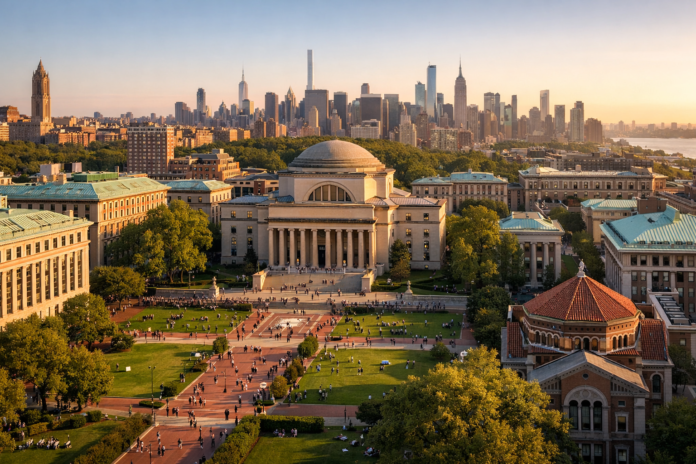
Columbia University is a private, non-profit Ivy League research university located in Morningside Heights, Manhattan, New York City, New York. Founded in 1754 as King’s College, it is the fifth-oldest institution of higher education in the United States and one of the nine original Colonial Colleges.
Columbia University in New York is situated on a 36-acre campus in Upper Manhattan, roughly 10 blocks north of Central Park. Its address 116th Street and Broadway places it at the heart of one of the most economically and culturally significant cities in the world, giving students direct access to global finance, law, media, and technology industries.
The university holds an R1 Carnegie Classification (Doctoral: Very High Research Activity) and competes in the Ivy League athletic conference under NCAA Division I. Total enrollment stands at approximately 36,000 students across undergraduate, graduate, and professional programs.
| Category | Details |
| Type | Private, Non-Profit Research University |
| Location | Morningside Heights, Manhattan, New York City, NY 10027 |
| Founded | 1754 (as King’s College) |
| Carnegie Classification | R1 — Doctoral: Very High Research Activity |
| Athletic Conference | Ivy League (NCAA Division I) |
| Total Enrollment | ~36,000 (undergraduate + graduate combined) |
| Endowment | ~$14.3 billion (2024) |
| Acceptance Rate | ~3.9% (Class of 2028) |
Read Also : Harvard University Cambridge – Proven Admissions, Programs, Fees, Scholarships & Career Outcomes (2026)
What Is Columbia University Known For?
Columbia University is known for several things that set it apart from other top research universities in the United States. First and most distinctively, it is one of only eight Ivy League universities in the country, a designation that carries significant weight with employers, graduate schools, and scholarship committees worldwide.
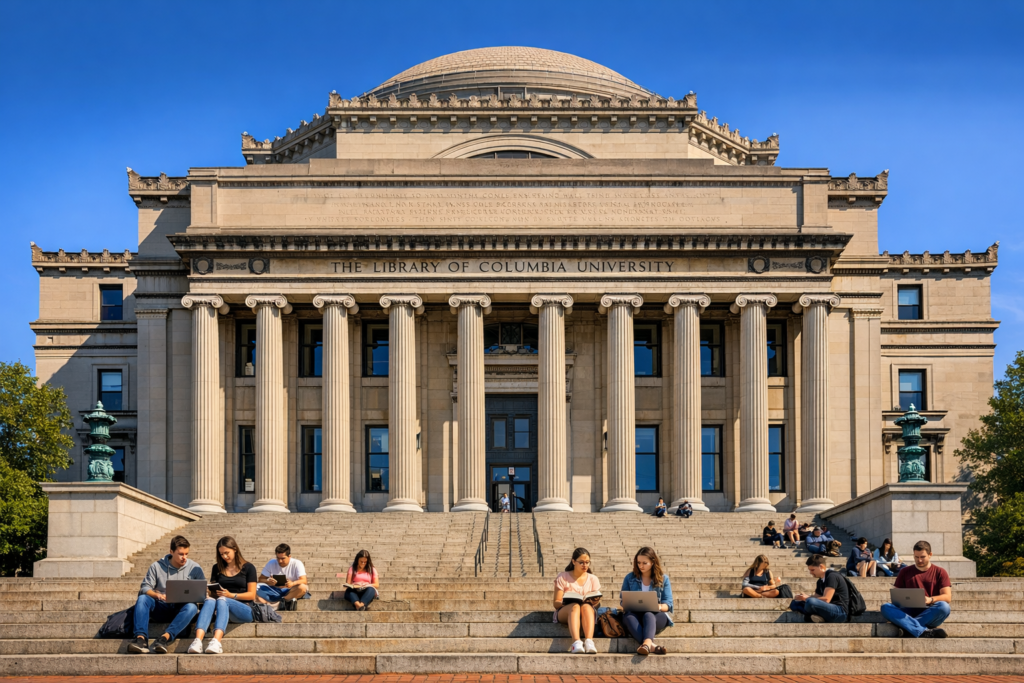
Beyond its Ivy League status, Columbia is internationally recognized for the following:
- The Core Curriculum — a mandatory sequence of courses in literature, philosophy, science, and music that no other Ivy League school fully replicates, and which produces broadly educated graduates sought after across industries
- Columbia Law School — consistently ranked in the top 5 nationally, with exceptional placement into federal clerkships and Big Law firms
- Columbia Business School — a top 10 MBA program globally, with deep Wall Street recruiting pipelines
- Columbia Journalism School — widely regarded as the most prestigious journalism graduate program in the United States
- Columbia Medical Center — one of the top medical research and clinical training environments in the country
- Nobel Laureates — 101 affiliated Nobel Prize winners, the highest count of any university in New York State
- New York City access — unmatched proximity to internships, corporate headquarters, global institutions, and cultural organizations
Return on Investment
Columbia graduates report a median mid-career salary of approximately $119,000 according to PayScale, placing it among the top-performing universities nationally for long-term earnings. For professional school graduates in law, business, and medicine, compensation levels are significantly higher.
Popular Academic Programs at Columbia University

Undergraduate Programs
Columbia College and the Fu Foundation School of Engineering and Applied Science (SEAS) form the undergraduate core. Admission to both is through the same application process, but students declare either a liberal arts or engineering track.
- Computer Science — top producer of software engineers hired by Google, Amazon, and Meta
- Economics — primary undergraduate pipeline to finance, consulting, and law
- Political Science — strong placement into law school, government, and policy roles
- Financial Economics — specialized track designed for investment banking and asset management careers
- Neuroscience and Behavior — highly structured pre-medical preparation
- Applied Mathematics — high demand from quantitative finance and data science employers.
Graduate and Professional Programs
- MBA — Columbia Business School, ranked top 10 globally; Wall Street recruiting is unrivaled
- JD — Columbia Law School, top 5 in the US; BigLaw placement rate exceeds 70%
- MS Computer Science / Data Science — SEAS, strong industry placement in tech and finance
- MPA / MIA — School of International and Public Affairs (SIPA), leading policy school
- MPH — Mailman School of Public Health, top ranked for epidemiology and health policy
- MA Journalism — Columbia Journalism School, gold standard for media careers
- MD — Vagelos College of Physicians and Surgeons, one of the top medical schools nationally
Read Also : University of Colorado Boulder – Admissions, Programs, Fees, Scholarships & Career Outcomes (2026)
Columbia University Admission Requirements
How to Apply to Columbia University as a US Student
Columbia University acceptance rate for the Class of 2028 was approximately 3.9%, making it one of the most selective universities in the country. Admission is holistic no single factor determines the outcome, but academic preparation is the baseline.
| Requirement | Details |
| Overall Acceptance Rate | ~3.9% (Class of 2028) |
| GPA (Median Admitted) | 4.17 weighted / 3.9+ unweighted strongly preferred |
| SAT Range (Middle 50%) | 1510 – 1570 |
| ACT Range (Middle 50%) | 34 – 36 |
| Test Policy (2026 Cycle) | Test-optional policy in effect |
| AP / IB Courses | Highly recommended; 8–12 AP courses typical for admitted students |
| Common App Essays | Main essay + Columbia-specific supplemental essays required |
| Recommendations | 2 teacher letters + 1 school counselor letter |
| Early Decision Deadline | November 1 |
| Regular Decision Deadline | January 1 |
Columbia University Requirements for International Students
International applicants follow the same holistic review process. English language proficiency documentation and a financial certification form are additionally required.
| Requirement | Details |
| TOEFL (Minimum Required) | 100 iBT (score of 110+ strongly preferred) |
| IELTS (Minimum Required) | 7.0 overall (7.5+ preferred) |
| Duolingo English Test | Not accepted |
| SAT / ACT | Same test-optional policy applies |
| Financial Documentation | Certification of Finances required for visa processing |
| Transcripts | Official secondary school records with certified translation if not in English |
| Financial Aid Eligibility | Need-blind admissions for international undergraduates |
| Application Portal | Common Application (commonapp.org) |
Columbia University is one of only a handful of universities globally that practices need-blind admissions for international undergraduate students, meaning financial circumstances do not factor into the admission decision.
Read Also : University of Pennsylvania Tuition Fees, Acceptance Rate, Admission, and Campus Life 2026
Columbia University Tuition & Fees (2025–2026)
As a private university, Columbia charges the same tuition for all undergraduate students regardless of state residency. There is no in-state versus out-of-state tuition distinction.
| Cost Category | US Students | International Students |
| Tuition (Annual) | $68,400 | $68,400 |
| Mandatory Fees | $3,400 | $3,400 |
| Room & Board (On-Campus, Est.) | $17,700 | $17,700 |
| Books & Supplies (Est.) | $1,100 | $1,100 |
| Personal Expenses (Est.) | $2,400 | $2,400 |
| Total Cost of Attendance (Est.) | $93,000 | $93,000 |
| Health Insurance (Optional) | $4,200 | $4,200 |
Graduate and professional program tuition varies significantly by school. Columbia Law School and Columbia Business School each charge tuition exceeding $75,000 per year for the 2025–2026 academic year. Always confirm current figures directly at finance.columbia.edu.
Columbia University Scholarships and Financial Aid
Columbia University meets 100% of demonstrated financial need for all admitted undergraduate students domestic and international alike. The university does not offer merit-only scholarships at the undergraduate level. All institutional aid is need-based.

| Aid Type | Amount / Details | Eligibility |
| Columbia Need-Based Grant | Average award: ~$62,000/year | All admitted undergrads with demonstrated financial need |
| Federal Pell Grant | Up to $7,395/year | US citizens; family income typically under $60,000 |
| Federal Direct Subsidized Loan | Up to $5,500/year (freshman year) | US citizens with demonstrated need; FAFSA required |
| Federal Work-Study Program | $2,500 – $4,000/year | US citizens; part-time on-campus employment |
| No-Loan Policy | Loans replaced with grants | Families earning under ~$150,000/year |
| FAFSA Submission Deadline | February 15 (priority) | All US applicants seeking federal aid |
| CSS Profile Required | Yes both domestic and international | Required for Columbia institutional aid consideration |
| PhD Fellowship (Graduate) | Full tuition + annual stipend | Most doctoral programs; varies by department |
| External Scholarships | Listed on Columbia scholarship portal | Varies; Columbia actively supports external applications |
For families with annual income below $65,000, Columbia’s financial aid package typically covers the full cost of attendance through grants, making the net price competitive with many public universities. Students from families earning between $65,000 and $150,000 also receive substantial grant support with little to no expected loan burden.
Read Also : University of Arizona Tuition Fees, Acceptance Rate, Admission, and Campus Life 2026
Columbia University Campus Life and Student Facilities
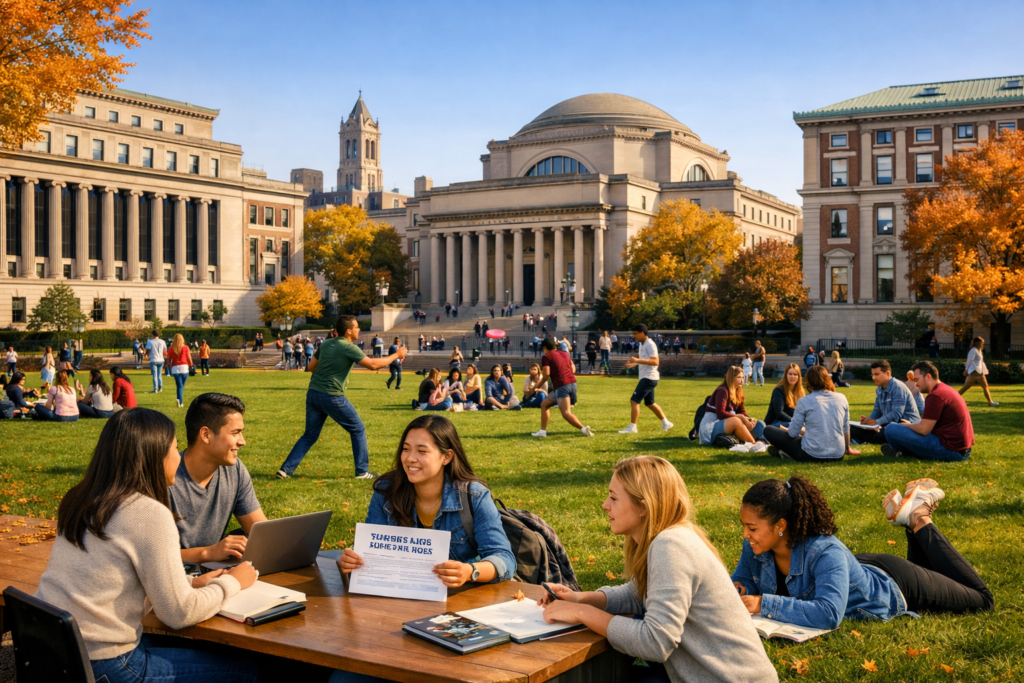
Columbia’s Morningside Heights campus offers a self-contained academic environment within one of the world’s most active cities. The campus architecture, featuring neoclassical buildings surrounding Low Plaza, is a recognized New York City landmark. A second campus in Manhattanville, West Harlem, houses Columbia Business School and several research centers.
Key Facilities
- Butler Library — 12+ million volumes; open 24 hours during finals periods; primary undergraduate research library
- Lerner Hall — central student hub with dining, event space, and offices for 500+ registered student organizations
- Dodge Fitness Center — full gym, swimming pool, indoor courts, and group fitness programming
- Columbia Health — comprehensive medical, mental health, and counseling services on campus
- Manhattanville Campus — modern facilities housing the Business School and interdisciplinary research institutes
- Earl Hall & Kraft Center — multi-faith and interfaith community spaces for student spiritual life
Student Life
Columbia has over 500 registered student organizations spanning cultural groups, political organizations, academic clubs, performance arts ensembles, and community service initiatives. The Columbia Daily Spectator, founded in 1877, is one of the oldest college newspapers in the United States. Greek life exists but is not dominant; the social scene is more shaped by New York City than by on-campus events.
Read Also : Iowa State University Cost of Attendance 2026: Tuition Fees, Admission, Jobs, Salary & Living in Ames Iowa
Columbia University Career Outcomes and Top Recruiters
Columbia’s Center for Career Education (CCE) manages employer partnerships, on-campus recruiting events, and career advising. The university’s location in New York City is the single largest structural advantage for career placement no campus visit is needed for students to attend interviews, internship placements, or networking events at major firms.

Employment & Salary Data
| Metric | Data |
| Employed or in Graduate School (6 months post-graduation) | ~93% of surveyed graduates |
| Median Starting Salary — All Undergraduate Majors | ~$75,000 |
| Median Starting Salary — Computer Science | ~$130,000 |
| Median Starting Salary — Finance / Economics | $90,000 – $110,000 |
| Median Base Salary — Columbia MBA (Business School) | ~$175,000 |
| Median Starting Salary — Columbia Law (BigLaw) | $215,000 |
| Median Mid-Career Salary — All Majors | ~$119,000 |
Top Employers Recruiting Columbia Students
- Finance & Banking: Goldman Sachs, JPMorgan Chase, Morgan Stanley, BlackRock, Citadel
- Consulting: McKinsey & Company, Boston Consulting Group, Deloitte, Bain & Company
- Technology: Google, Amazon, Microsoft, Meta, Apple, Bloomberg
- Law: Cravath, Sullivan & Cromwell, Davis Polk, Skadden (all BigLaw firms at $215K+ starting)
- Media & Journalism: The New York Times, NBC Universal, Reuters, The Associated Press
- Healthcare & Pharma: Pfizer, Johnson & Johnson, Memorial Sloan Kettering Cancer Center
- Public Sector & NGOs: United Nations, World Bank, US State Department, Council on Foreign Relations
Read Also : University of Kansas (2026): Tuition, Acceptance Rate, Ranking, Scholarships & Is It Worth the Cost?
Columbia University Housing and Living Costs
Columbia University guarantees on-campus housing for all four years of undergraduate study — a rare commitment among urban universities. Graduate student housing is available through the university but is limited and allocated competitively.
| Expense | On-Campus (Est.) | Off-Campus NYC (Est.) |
| Rent / Housing (Monthly) | $1,475 (included in room & board) | $1,800 – $3,500+ |
| Meals (Monthly) | $600 (dining plan) | $500 – $900 |
| Local Transportation (Monthly) | $150 (NYC MetroCard) | $150 |
| Books & Supplies (Annual) | $1,100 | $1,100 |
| Personal / Entertainment (Monthly) | $200 – $400 | $300 – $600 |
| Total Monthly Cost (Est.) | $2,400 – $2,700 | $3,000 – $5,500+ |
| Total Annual Living Cost (Est.) | $25,000 – $32,000 | $36,000 – $66,000+ |
First-year students are required to live on campus. International students are especially encouraged to secure on-campus housing for their first year, as Manhattan rental prices rank among the highest in the country. Students willing to commute from Brooklyn or Queens can reduce housing costs meaningfully, though commute times should be factored into academic planning.
Final Verdict: Who Should Apply to Columbia University?
Columbia is an excellent fit if you:
- Are targeting finance, law, consulting, media, or technology careers and want the most direct possible employer access in the United States
- Come from a low or middle-income household and qualify for need-based aid Columbia’s no-loan policy makes it genuinely affordable for many families who assume it is out of reach
- Are applying to competitive professional schools and want the full weight of an Ivy League undergraduate degree behind your application
- Thrive in a dense, intellectually intense, urban academic environment
- Are an international student seeking US career placement in a globally connected city
- Want to be part of one of the most powerful alumni networks in the world
You should reconsider if you:
- Prefer a traditional college-town environment, green campus, or slower pace of life
- Expect merit scholarships — Columbia does not offer merit-only undergraduate aid
- Have a GPA and test profile significantly below the middle 50% range of admitted students
- Are focused on fields where other universities hold a clear advantage, such as agriculture, veterinary science, or performing arts at conservatory level
Frequently Asked Questions
Where is Columbia University?
Columbia University is located in Morningside Heights, Manhattan, New York City, New York. The main campus sits at the intersection of 116th Street and Broadway in Upper Manhattan. The Manhattanville campus, home to Columbia Business School, is located a few blocks north in West Harlem.
Is Columbia University an Ivy League school?
Yes. Columbia University is an Ivy League university. It is one of eight institutions in the Ivy League, alongside Harvard, Yale, Princeton, Penn, Brown, Dartmouth, and Cornell. Columbia has been a member of the Ivy League since the conference was formally established in 1954, though its academic and athletic rivalries with the other Ivy institutions date back to the 18th century.
Is Columbia an Ivy League university — does that matter for jobs?
Yes, and for many employers it matters significantly. The Ivy League designation carries weight in competitive hiring processes at investment banks, law firms, consulting firms, and graduate school admissions committees. However, Columbia’s location in New York City arguably matters as much as the Ivy League brand itself students have direct access to employers without needing to travel for recruiting events.
What is Columbia University’s acceptance rate?
Columbia University’s acceptance rate for the Class of 2028 was approximately 3.9%, making it one of the most selective universities in the United States. Early Decision applicants are accepted at a slightly higher rate, though the advantage is modest compared to the overall pool selectivity.
What is Columbia University known for academically?
Columbia University is known for the Core Curriculum at the undergraduate level, which is a required sequence of courses in Western literature, philosophy, art, music, and science that all students complete regardless of major. At the professional level, Columbia is especially known for its Law School (top 5 nationally), Business School (top 10 globally), Journalism School (widely considered the best in the US), and Mailman School of Public Health. Its research output in biomedical science, economics, and social science is among the highest of any university in the world.
Where is Columbia University in New York — is it safe?
Columbia University is located in Morningside Heights, a neighborhood in Upper Manhattan that has historically been considered one of the safer residential areas of Manhattan due to its strong academic community anchor. The university operates its own public safety department and maintains 24-hour security across campus. Like any urban campus, students are advised to stay aware of their surroundings, but safety at Columbia compares favorably with other major urban universities in the United States.
How does Columbia University compare to the University of British Columbia?
Columbia University in New York City and the University of British Columbia (UBC) in Vancouver, Canada, are both highly ranked research universities, but they serve different markets and student profiles. Columbia is a private Ivy League university with a 3.9% acceptance rate and strong placement into US finance, law, and consulting. UBC is a large Canadian public university with a broader acceptance profile and lower tuition, particularly for Canadian residents. For US students and international students targeting US career markets, Columbia offers a stronger direct pipeline. For students interested in Canadian careers or research in natural sciences and engineering, UBC is a top-tier choice.
Does Columbia University offer financial aid to international students?
Yes. Columbia University is need-blind for international undergraduate applicants, meaning it does not consider financial circumstances when making admissions decisions for international students. Admitted international undergraduates are eligible for the same need-based grant aid as domestic students, and Columbia meets 100% of demonstrated financial need. This is exceptionally rare among US universities and makes Columbia meaningfully more accessible for international students than its sticker price suggests.
Read Also : University of Nebraska Lincoln (UNL): Complete Overview for US & International Students (2025–26)

