

Thinking about becoming a software engineer in the USA? Before you invest years into this career path, here’s everything you need to know — the real salary numbers, the brutal job market competition, the visa process nobody explains clearly, and whether this career is actually right for you in 2026.
What Does a Software Engineer Actually Do in the USA?
Let’s skip the glossy job descriptions. A software engineer in the USA spends the majority of their workday writing, reviewing, and debugging code primarily in languages like Python, JavaScript, Java, or Go. But the job is far more than typing code into a screen.
In a typical American tech company, your day looks like this: morning standup (15-minute team sync), 3–5 hours of actual coding, code reviews for teammates, resolving bugs escalated from production, and sometimes sitting in long product planning meetings. At larger companies like Google, Meta, or Amazon, the engineering work is more specialized and bureaucratic. At startups, you wear multiple hats — you might be writing backend APIs in the morning and configuring cloud infrastructure in the afternoon.
The USA software engineering market is still one of the strongest in the world, but it has fundamentally shifted since 2021–2022. The explosive “hire everyone” era is over. Companies are now demanding more productivity from smaller teams, and AI coding tools like GitHub Copilot have changed what a single engineer can output in a day. Demand still exists — particularly in enterprise software, healthcare tech, defense, and AI infrastructure but the days of getting hired with just a bootcamp certificate and a GitHub portfolio are largely gone at top-tier companies.
Skills Every Software Engineer in the USA Must Have (2026)
You will not get past the first technical screening without solid fundamentals in at least one of these areas:
- Programming proficiency in Python, JavaScript/TypeScript, Java, or C++ — not surface-level, but enough to pass LeetCode-style algorithmic questions
- Data structures and algorithms — linked lists, trees, graphs, dynamic programming. This is tested in every FAANG and mid-tier tech company interview
- Version control with Git — branching, merging, pull requests
- Basic cloud knowledge — AWS, Azure, or GCP at the services level (S3, EC2, Lambda are commonly asked)
- Databases — SQL proficiency plus exposure to NoSQL (MongoDB, DynamoDB)
- System design fundamentals — how to design scalable APIs, understand load balancers, caching strategies
Good-to-Have Software Engineer Skills
| Skill Category | Tools/Technologies | Why It Matters |
| AI/ML Integration | LangChain, OpenAI API, PyTorch | Most companies now embed AI features |
| DevOps/CI-CD | Docker, Kubernetes, GitHub Actions | Reduces dependency on separate DevOps teams |
| Mobile Development | React Native, Swift, Kotlin | Expands job target pool significantly |
| Security Awareness | OWASP, OAuth2, JWT | Required at fintech and healthcare companies |
| Testing | Jest, Pytest, Selenium | Code without tests rarely passes code review |
Read Also : How to Become a Cloud Engineer in the USA (2026): Salary, Skills, Jobs & Requirements
Software Engineer Salary in the USA – Full Breakdown (2026)
Software engineering salaries in the USA vary significantly by company tier, location, and experience level. The numbers below reflect total compensation (base salary + bonus + stock), which is how compensation is actually discussed in the US tech industry.
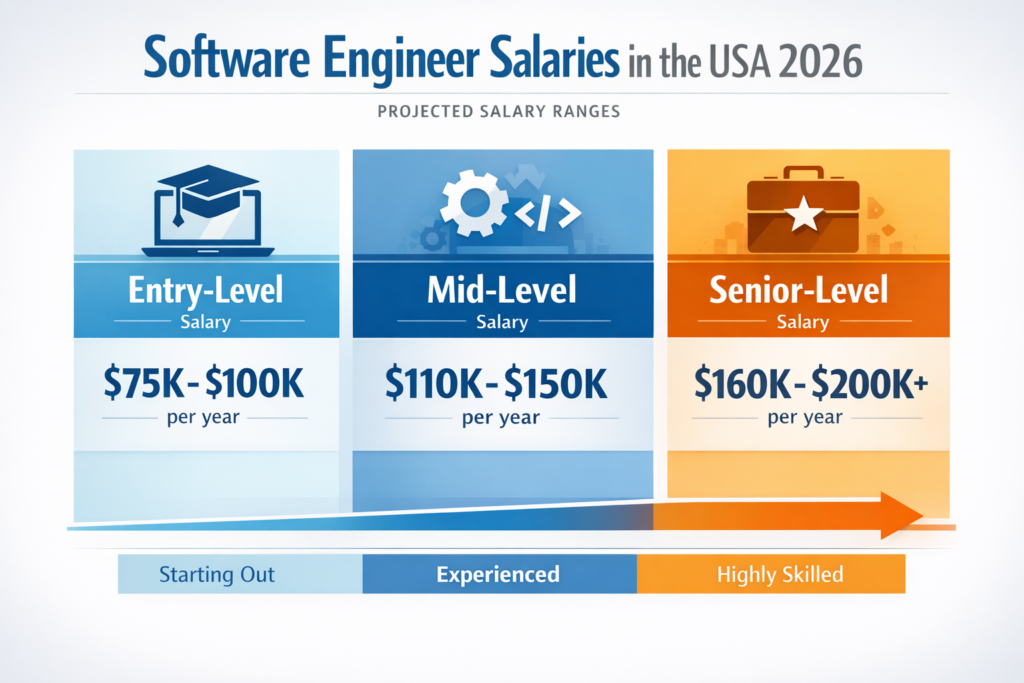
Software Engineer Salary by Experience Level (2026)
| Experience Level | Years of Experience | Base Salary Range | Total Comp (with stock/bonus) | Common Employers |
| Entry-Level (SWE I) | 0–2 years | $90,000 – $130,000 | $110,000 – $180,000 | Mid-size tech, startups, regional companies |
| Mid-Level (SWE II) | 3–6 years | $130,000 – $175,000 | $160,000 – $280,000 | Established tech firms, big banks |
| Senior (Senior SWE) | 7+ years | $170,000 – $240,000+ | $250,000 – $600,000+ | FAANG, unicorn startups |
Software Engineer Salary by Company Tier
| Company Tier | Examples | Entry-Level Total Comp | Senior Total Comp |
| Tier 1 (FAANG+) | Google, Meta, Apple, Amazon, Microsoft | $180,000 – $220,000 | $400,000 – $800,000+ |
| Tier 2 (Strong Tech) | Salesforce, Adobe, Stripe, Airbnb | $140,000 – $180,000 | $250,000 – $450,000 |
| Tier 3 (Mid-market) | Regional banks, insurance tech, SaaS startups | $90,000 – $130,000 | $150,000 – $220,000 |
Key reality: Levels.fyi data from 2025–2026 confirms that the median total compensation for a software engineer in the USA is approximately $165,000 per year across all levels. Entry-level at non-FAANG companies often starts around $90,000–$110,000 — not $200,000, despite what LinkedIn posts suggest.
Read Also : Risk Analyst Jobs in 2026: The Ultimate Guide to US Laws, Sanctions, and Career Success
Education and Certifications Required to Become a Software Engineer in the USA
The USA tech industry is more credential-flexible than most countries, but that doesn’t mean education doesn’t matter.
A 4-year Computer Science degree from an accredited US university remains the gold standard for H-1B sponsorship, large employer hiring pipelines, and government/defense contracting roles. Top employers like Google, Amazon, and Microsoft will hire from bootcamps, but it is statistically harder — their internal referral and university recruiting pipelines heavily favor CS degree holders.
For immigrants and international students specifically, a CS or related STEM degree significantly improves your visa options (more on this below).
Certifications that actually matter in the US job market:
- AWS Certified Solutions Architect (Associate or Professional) -genuinely valued at enterprise employers
- Google Professional Cloud Developer
- Certified Kubernetes Administrator (CKA) — strong signal for DevOps-adjacent roles
- Meta (Facebook) Certified Developer — limited value outside Meta’s ecosystem
Bootcamp reality check: Coding bootcamps (General Assembly, Flatiron, App Academy) can help career switchers break in, but expect lower starting salaries ($65,000–$85,000) and fierce competition for entry-level roles. A bootcamp alone will not get you H-1B sponsorship — employers sponsoring visas almost exclusively require a 4-year degree.
Software Engineer Job Market Reality in the USA (2026)
The US software engineering market in 2026 is a tale of two realities. If you’re applying to the top 20% of companies (FAANG, well-funded startups, major banks), the interview bar has never been higher and the number of applicants per role has never been larger. If you’re targeting mid-market or enterprise companies outside of tech hubs, there’s actually less competition and more hiring stability.

What the numbers actually show:
- According to the US Bureau of Labor Statistics, software developer jobs are projected to grow 25% from 2022 to 2032 — far above the average for all occupations
- Despite this growth projection, the tech layoff cycle of 2022–2024 eliminated over 250,000 US tech jobs, with FAANG companies leading the cuts
- Job openings at FAANG-tier companies remain intensely competitive, with some roles receiving 1,000+ applications within 48 hours of posting
Sectors with Actual Hiring Activity in 2026:
- Defense and aerospace tech (requires US citizenship or permanent residency)
- Healthcare technology and electronic health records
- Financial services and fintech
- AI/ML engineering (particularly prompt engineering and LLM integration roles)
- Government IT contracting (citizenship-restricted for most roles)
Honest assessment: The job market is competitive, not dead. Engineers with 3+ years of experience and demonstrated cloud or AI skills are getting hired consistently. New graduates and career switchers face the hardest path.
Read Also : The Complete Guide to Sanctions Analyst Jobs in USA 2026: OFAC, AML, KYC, CTR, Laws, Salary & Career Path
Visa and Work Authorization for Software Engineers in the USA
This is where most international job seekers get blindsided. Here is a plain-English breakdown of your realistic options:

Software Engineer Visa Options by Status
| Visa/Status | Who It’s For | Key Limitation | Employer Sponsor Needed? |
| F-1 OPT | International students (post-graduation) | 12 months (STEM: 36 months) | No, during OPT period |
| H-1B | Skilled workers in specialty occupations | Annual lottery (65,000 cap + 20,000 MS cap) | Yes, mandatory |
| L-1 | Intracompany transfers | Must work for same company 1+ year abroad | Yes |
| O-1A | Extraordinary ability workers | Very high bar to qualify | Yes |
| Green Card (EB-2/EB-3) | Permanent residency | Wait times: 5–20+ years for India-born | Yes (employer-sponsored) |
Critical reality for Indian and Chinese nationals: The H-1B backlog for India-born applicants is catastrophically long. EB-3 green card wait times for Indian nationals currently exceed 50 years based on current quota consumption rates. This is not an exaggeration — it is the documented reality published in the US Department of State Visa Bulletin. Many Indian software engineers on H-1B remain in work visa limbo for their entire careers.
OPT Strategy: If you’re an international student on F-1 visa, your 36-month STEM OPT window is your most important job-hunting period. Use it to build US work experience, get an H-1B sponsorship commitment from your employer before your OPT expires, and understand that H-1B lottery failure is a real possibility (the lottery selection rate in 2024 was approximately 14%).
Read Also : Forklift Operator Jobs in USA 2026: High Paying Career Guide, Salary, Visa & Future Trends
Best States and Cities for Software Engineers in the USA
Not all US cities are equal for software engineering jobs. Cost of living, salary levels, visa-sponsor density, and job availability vary dramatically.

Top Locations for Software Engineers in the USA
| City/Metro | Average SWE Salary | Cost of Living Index | Visa Sponsors Available | Best For |
| San Francisco Bay Area, CA | $185,000 – $220,000 | Extremely High | Highest density | FAANG, AI startups |
| Seattle, WA | $165,000 – $200,000 | Very High | High | Amazon, Microsoft, startups |
| New York City, NY | $155,000 – $190,000 | Very High | High | Fintech, media tech, startups |
| Austin, TX | $130,000 – $165,000 | Moderate-High | Moderate | Dell, Apple, IBM, startups |
| Raleigh-Durham, NC | $115,000 – $145,000 | Moderate | Moderate | IBM, Red Hat, SAS |
| Chicago, IL | $120,000 – $155,000 | Moderate | Moderate | Fintech, Accenture |
| Pittsburgh, PA | $110,000 – $140,000 | Lower | Moderate | CMU research, robotics |
For immigrants specifically: The San Francisco Bay Area and Seattle have the highest concentration of companies willing and experienced in H-1B sponsorship. However, if your goal is quality of life and long-term stability over maximum salary, cities like Austin, Raleigh, or Chicago offer strong tech job markets at significantly lower living costs.
Read Also : Uber Eats Driver in the USA – Salary, Skills, Visa, and Reality Check (2026)
How to Get Hired as a Software Engineer in the USA Faster
The engineers getting hired in 2026 are not the ones with the most impressive resumes — they are the ones with the most targeted, deliberate job search strategies.
Step 1: Fix your interview preparation first. Before applying anywhere, spend 6–8 weeks doing consistent LeetCode practice (medium difficulty, 2–3 problems daily). Most rejections at mid-to-large tech companies happen at the technical phone screen, not the resume screen.
Step 2: Build a portfolio that solves a real problem. One genuinely useful project — a deployed web app with real users, an open-source contribution with merged pull requests, or a data pipeline solving an actual business problem — carries more weight than 10 toy tutorial projects.
Step 3: Get on LinkedIn and be specific. “Software Engineer” as your headline will bury you in search results. “Backend Python Engineer | AWS | Fintech” makes you findable by the recruiters actually hiring.
Step 4: Target companies that sponsor visas (if you need one). Use myvisajobs.com and h1bdata.info to identify the exact companies sponsoring H-1B in your specialty. Apply to them before applying to companies with no visa sponsorship history.
Step 5: Referrals convert at 10x the rate of cold applications. One warm referral from a current employee at your target company is worth more than 100 cold applications through the careers portal. Invest time in building genuine connections on LinkedIn, attending tech meetups, and engaging with communities on GitHub and Discord.
Step 6: Negotiate your offer. US tech companies consistently make initial offers 10–20% below the maximum they are willing to pay. Always negotiate. Use Levels.fyi and Glassdoor to benchmark your offer before accepting.
Common Mistakes Software Engineers Make When Job Hunting in the USA
Many talented engineers fail in the US job market not because of technical skills, but because of avoidable strategic errors.
Mistake 1: Applying to hundreds of jobs with the same generic resume. The USA hiring system uses applicant tracking systems (ATS) that filter resumes by keyword matching. A resume not tailored to the specific job description often never reaches a human reviewer.
Mistake 2: Neglecting system design interviews. Many international candidates are strong at algorithms but unprepared for the open-ended “design a URL shortener” or “design Twitter’s feed” type questions. These are heavily weighted at mid and senior levels.
Mistake 3: Underestimating the culture fit / behavioral interview component. US tech companies heavily use the STAR method (Situation, Task, Action, Result) behavioral interviews. Engineers who struggle to articulate their contributions in English narrative form lose offers to less technically strong candidates who communicate better.
Mistake 4: Accepting the first offer without negotiating. Particularly common among first-time US job seekers and immigrants who fear losing the offer. In reality, rescinding an offer over a polite salary negotiation is extremely rare in the US tech industry.
Mistake 5: Not understanding your visa timeline. Missing the H-1B filing window (April 1 annually), not converting from OPT to H-1B in time, or accepting a job at a company that cannot legally sponsor your visa are career-derailing mistakes that could have been avoided with basic research.
Mistake 6: Ignoring company stability while chasing big brand names. Post-2022 layoffs have proven that even the biggest tech companies can eliminate entire divisions overnight. Research a company’s revenue model, runway (for startups), and recent financial news before accepting an offer.
Read Also : Solar Panel Installer Jobs in USA (2026) — Salary Companies & Hiring Cities
Final Verdict – Is Software Engineer the Right Career for You in the USA?
Software engineering in the USA in 2026 is still one of the most financially rewarding and globally respected career paths available. But it is not the right move for everyone, and the gap between success and struggle is often more about strategy than raw talent.
Software engineering in the USA in 2026 is still one of the most financially rewarding and globally respected career paths available. But it is not the right move for everyone, and the gap between success and struggle is often more about strategy than raw talent.
This career path makes strong sense if you:
- Have or are pursuing a 4-year STEM degree and plan to leverage it for visa sponsorship
- Are genuinely interested in technology and willing to keep learning continuously (the tools change fast — what’s hot today may be irrelevant in 3 years)
- Have strong problem-solving instincts and enjoy the deep focus required for coding
- Are comfortable with ambiguity — you won’t always be told exactly what to build or how
- As an international student, have a realistic understanding of the H-1B lottery risk and a backup plan if the lottery doesn’t work in your favor
- Are a career switcher with a strong adjacent background (finance, healthcare, engineering) who wants to move into software — domain expertise plus coding skills is a rare and valuable combination
This career path is a harder road if you:
- Are pursuing it purely for salary without genuine interest in the work
- Do not have a clear visa pathway and are counting on H-1B sponsorship working out on the first try
- Are unwilling to invest significant time in interview preparation outside of work hours
- Live outside of a major tech hub and are not open to relocation or remote-first companies
The reality is direct: software engineering in the USA rewards those who prepare systematically, navigate the visa landscape intelligently, and invest in building real relationships in the industry — not just submitting applications into a void. The opportunity is still real. The path requires clear eyes.
Read Also : Plumber Salary in the USA (2026): Highest & Lowest Paying States, Hiring Companies, Visa Reality
Frequently Asked Questions – Software Engineer in the USA
Q1: What is the minimum salary for a software engineer in the USA in 2026?
The federal H-1B prevailing wage floor for software engineers varies by location but typically starts at $85,000–$95,000 per year for entry-level roles in non-tech-hub cities. In San Francisco or New York, the effective floor is closer to $110,000–$120,000 for entry-level positions at established companies.
Q2: Can I get a software engineer job in the USA without a Computer Science degree?
Yes, but it is significantly harder and has important limitations. Bootcamp graduates and self-taught engineers can and do get hired, primarily at startups and smaller companies. However, without a 4-year STEM degree, employer-sponsored H-1B visas become essentially inaccessible, and FAANG-tier hiring pipelines are very difficult to access.
Q3: How competitive is the H-1B lottery for software engineers in the USA in 2026?
The H-1B lottery selection rate has hovered around 14–20% in recent years (across all registrants). That means in any given year, roughly 80–86% of eligible applicants do not receive H-1B approval through the lottery. Companies like Google, Amazon, and Microsoft file for large numbers of employees, improving individual odds slightly — but lottery risk remains a real career planning factor.
Q4: Is remote work still common for software engineers in the USA?
Remote work availability has contracted since 2022–2023 when most major tech companies implemented return-to-office mandates. In 2026, the reality is a mixed landscape: pure remote roles exist but are more competitive; hybrid (2–3 days in office) is now the most common arrangement at established companies; startups remain more remote-flexible. For international candidates on work visas, note that your visa is tied to a specific work location — fully remote setups across state lines can create legal compliance issues.
Q5: How long does it take to become a software engineer and get hired in the USA?
For someone starting from zero with a CS degree program: typically 4 years to first job. For a career switcher with a coding bootcamp: 6–18 months to first junior role, depending on prior experience, job market conditions, and interview preparation. For an international transfer with existing software engineering experience: timeline depends primarily on visa pathway — OPT/H-1B filings can take 3–9 months.
Q6: Which programming language should a software engineer learn for the best job prospects in the USA?
In 2026, Python remains the most versatile and in-demand language across data engineering, AI/ML, backend development, and automation. JavaScript/TypeScript dominates frontend and full-stack web development. Java and C# are heavily used in enterprise environments. If you are starting from scratch with no prior programming background, Python is the highest-leverage first language for the current US job market.
Q7: Will AI replace software engineers in the USA?
The more accurate framing: AI is replacing certain tasks within software engineering (boilerplate code generation, basic debugging, documentation), not the profession. Engineers who adapt — learning to work with AI coding tools and focusing on system design, architecture, and business problem-solving — are more productive and more valuable than ever. The engineers most at risk are those doing purely repetitive, low-complexity coding work with no adjacent domain expertise.
Q8: What is the realistic green card path for a software engineer from India working in the USA?
This is one of the most difficult realities in US immigration. The EB-3 and EB-2 priority date backlog for India-born nationals is currently estimated at 50+ years at current processing rates. Practical strategies being used by Indian software engineers include: EB-1A extraordinary ability petitions (high bar but no country quota), Canada or Australia as intermediate permanent residency destinations with easier immigration paths, and National Interest Waiver (NIW) EB-2 petitions for those with strong research backgrounds. This requires consultation with an experienced US immigration attorney — generalized advice cannot substitute for case-specific legal guidance.
Read Also : Electrician Jobs in the USA: Salary, Apprenticeship & How to Get Hired 2026.

