

You have seen the headlines. Investment bankers make $200,000 straight out of college. The Goldman Sachs analyst lifestyle. The prestige. But here is what those headlines leave out: 100-hour work weeks, brutal recruiting filters, a razor-thin entry gate for immigrants, and a job market that has shed thousands of roles since 2022. Before you spend two years preparing for this career, read this guide. It covers what investment banking in the USA actually looks like in 2026 — the salary, the visa reality, the competition, and who should realistically pursue it.
What Is an Investment Banker?
What Does an Investment Banker Do Day-to-Day
An investment banker in the USA advises corporations, governments, and institutions on major financial transactions. This includes mergers and acquisitions (M&A), initial public offerings (IPOs), debt financing, and capital raising. You are not managing personal portfolios — that is a different field. Your clients are companies, not individuals.
On a typical day as an analyst or associate, expect to spend 60–80% of your time in Excel building financial models, 20–30% creating pitch decks and presentations in PowerPoint, and the remaining time in client calls, internal meetings, and due diligence reviews. The glamour is mostly on LinkedIn. The reality is staring at spreadsheets at 2 AM, fixing formatting issues flagged by a VP, and preparing 80-page pitch books for deals that may never close.
Roles are typically structured in a strict hierarchy: Analyst (2–3 years) → Associate → Vice President → Director/Executive Director → Managing Director. Analysts are recruited directly from undergraduate programs at target schools. Associates typically come from top MBA programs or are promoted internally.

Demand for Investment Banking Jobs in 2026
According to the U.S. Bureau of Labor Statistics, securities and financial services occupations are projected to grow about 7% through 2032. However, investment banking specifically — particularly at the bulge bracket and elite boutique level — remains extremely selective with a small total headcount. There are roughly 3,000–4,000 full-time analyst-level investment banking positions filled annually across all U.S. firms. That is a tiny funnel for a profession that tens of thousands of people target each year.
The 2022–2023 dealmaking slowdown led to significant layoffs at Goldman Sachs, Morgan Stanley, Lazard, and other major firms. While 2024–2025 saw a partial recovery in M&A volumes, hiring remains cautious. The market rewards specialists: those with strong M&A, restructuring, or sector-specific expertise have better prospects than generalists.
Read Also : Software Engineer in the USA – Salary, Skills, Visa, Reality Check (2026)
Skills Required to Become an Investment Banker
Must-Have Skills for Investment Banking
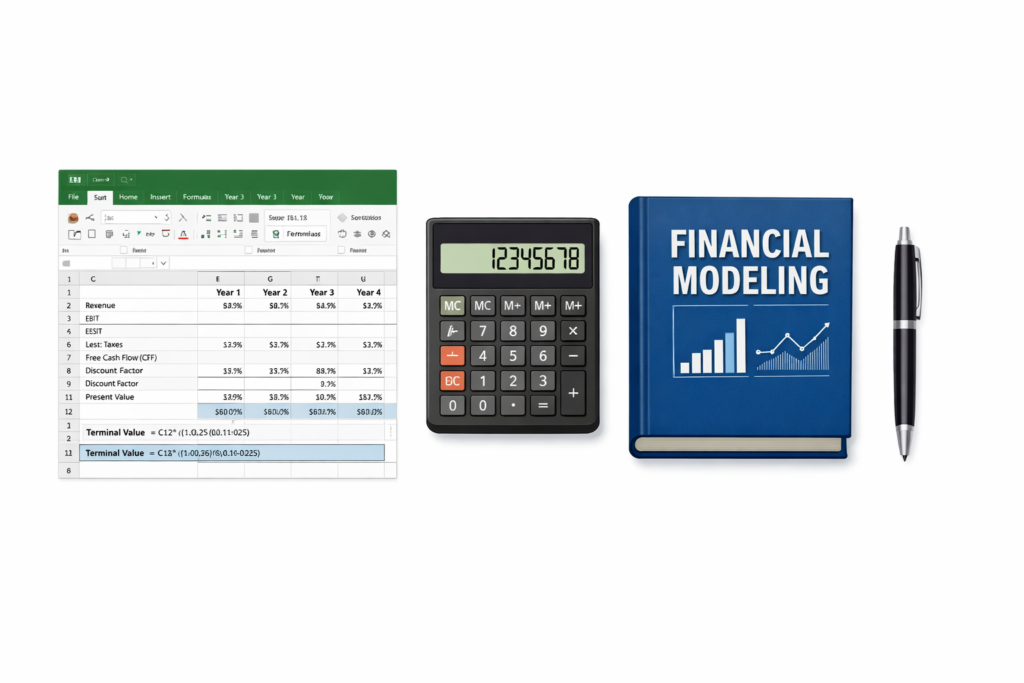
- Financial modeling: You must be proficient in building DCF (discounted cash flow), LBO (leveraged buyout), and comparable company analysis models in Excel. These are tested in technical interviews.
- Accounting fundamentals: Deep knowledge of the three financial statements — income statement, balance sheet, and cash flow — and how they link together.
- Valuation: Understanding different valuation methodologies and when to apply each. This is core to almost every deal.
- PowerPoint and data presentation: Pitch books need to be visually clean and factually dense. Speed and precision matter.
- Attention to detail: A single error in a financial model can cost a deal. Banks weed out candidates who make careless mistakes.
- Stamina and time management: The hours are not a myth. Analysts routinely work 80–100 hours per week during live deals. If this is not something you can handle physically and mentally, this career will break you.
Good-to-Have Skills in Investment Banking
- SQL and Python basics: Increasingly valued for data-heavy sectors like tech or healthcare banking.
- CFA Level 1: Not required for entry-level, but demonstrates commitment and financial knowledge.
- Industry expertise: If you have a background in healthcare, tech, real estate, or energy, sector-focused banking groups will value that domain knowledge.
- Foreign language skills: Useful for international deal teams, particularly in cross-border M&A.
- Bloomberg Terminal proficiency: Familiarity with financial data platforms is a plus at most firms.
Read Also : How to Become a Cloud Engineer in the USA (2026): Salary, Skills, Jobs & Requirements
Investment Banker Salary in the USA
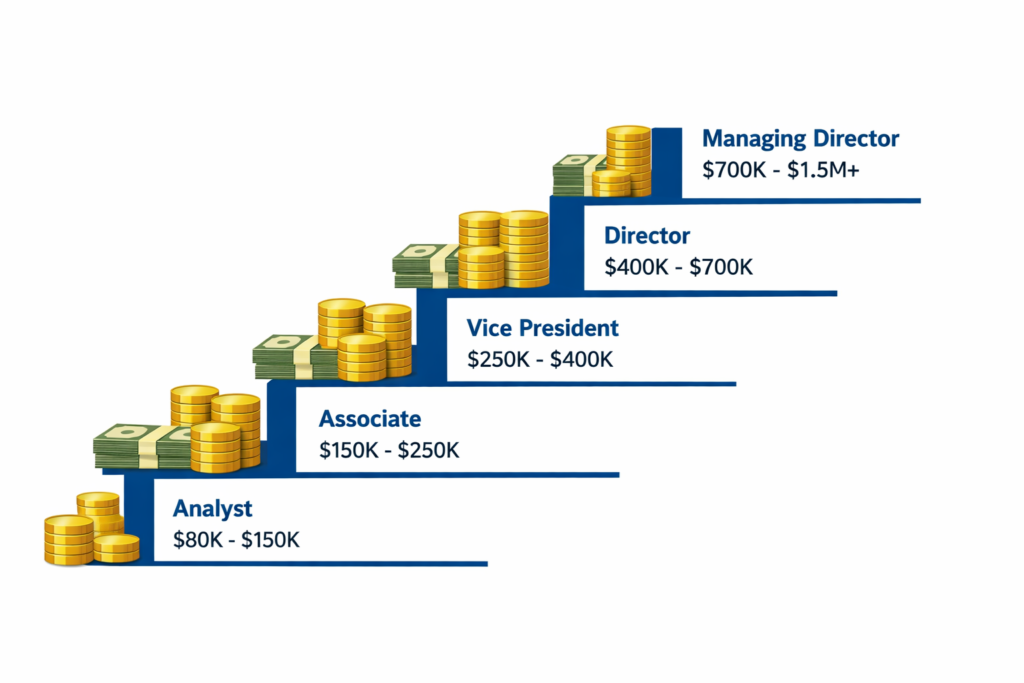
Investment banking salary in the USA is one of the highest at entry level for any profession. But the total compensation includes a base salary and a performance-based bonus — and the bonus can swing dramatically based on firm performance and deal activity.
| Level | Base Salary | Bonus | Total Comp |
| Analyst (Yr 1–2) | $110,000–$130,000 | $70,000–$100,000 | $180,000–$230,000 |
| Analyst (Yr 3) | $130,000–$150,000 | $90,000–$130,000 | $220,000–$280,000 |
| Associate (MBA) | $175,000–$200,000 | $100,000–$175,000 | $275,000–$375,000 |
| Vice President | $225,000–$275,000 | $200,000–$400,000 | $425,000–$675,000 |
| Managing Director | $300,000+ | $500,000–$2M+ | $800,000–$3M+ |
Note: These figures represent bulge bracket and elite boutique compensation. Regional banks and middle-market firms typically pay 20–40% less. Bonuses are not guaranteed — in down years like 2023, many analysts received significantly reduced bonuses. Cost of living in New York City or San Francisco will also absorb a substantial portion of this income.
Education & Certifications for Investment Banking in the USA
Undergraduate Path Into Investment Banking
The majority of investment banking analysts are recruited from a narrow set of ‘target schools’ — universities where bulge bracket banks actively recruit and have established campus relationships. These include Ivy League schools (Harvard, Penn/Wharton, Columbia), MIT, University of Chicago, Duke, Northwestern, NYU Stern, and a few others. Attending a non-target school is not disqualifying, but it requires significantly more self-advocacy, networking, and off-cycle application effort.
The most common undergraduate majors are finance, economics, accounting, and mathematics. However, engineers and computer science graduates increasingly enter investment banking, particularly in technology-focused groups.

MBA Route for Investment Banking Associates
For career switchers or international professionals who want to break into investment banking from a non-finance background, a top-tier MBA is the most reliable route. Banks recruit associates from a specific list of MBA programs, including Harvard Business School, Wharton, Booth, Kellogg, Columbia Business School, Stern, and Tuck. An MBA from a school outside the top 15–20 will rarely get you into bulge bracket banking.
Certifications That Help You Get Into Investment Banking
- FINRA Series 63, 79: Required once you are employed. The firm typically sponsors and requires these within the first few months of employment.
- CFA (Chartered Financial Analyst): Not required for IB roles but respected, especially in research-adjacent or credit roles.
- Wall Street Prep / Breaking Into Wall Street: These are not formal certifications, but completing financial modeling courses from these platforms is widely expected and tested in interviews.
Read Also : Risk Analyst Jobs in 2026: The Ultimate Guide to US Laws, Sanctions, and Career Success
Investment Banking Job Market Reality — Competition & Layoffs
How Competitive Is Investment Banking Recruiting?
Investment banking recruiting is among the most competitive hiring processes in any profession in the United States. For a single analyst class at a major bank in New York, banks may receive 5,000–15,000 applications for 30–80 spots. The process is highly structured: online applications in June–August, HireVue video interviews, superday (in-person interview rounds) in September–November, and offers extended before many candidates have even finished their junior year of college.
For international students, the competition is even tighter. Many firms have historically limited or avoided sponsoring visas for analysts due to the cost and complexity. This is a major barrier discussed in the next section.

Layoffs & Volatility Risk in Investment Banking
Investment banking headcount is directly tied to deal activity. When interest rates rose sharply in 2022, M&A and IPO markets froze. Goldman Sachs laid off over 3,000 employees in early 2023. Lazard, Morgan Stanley, and others followed. The boom-and-bust cycle is a fundamental characteristic of this industry — not an exception.
Even after securing a job, you are never fully insulated. Junior bankers can be let go during slow periods, and managing directors are fired if they fail to generate deal flow. This is a performance-driven environment with limited job security compared to other high-paying professional tracks.
Growth Areas in Investment Banking (2026)
Despite the volatility, there are growth pockets. Healthcare M&A, technology sector banking, infrastructure finance, and restructuring advisory have seen sustained demand. Boutique advisory firms focused on sector niches are often more stable than the bulge bracket behemoths when markets turn.
Read Also : The Complete Guide to Sanctions Analyst Jobs in USA 2026: OFAC, AML, KYC, CTR, Laws, Salary & Career Path
Visa and Work Authorization for Investment Banking in the USA
This is the section most career guides avoid. For immigrants and international students, the visa situation in investment banking is significantly harder than in tech.

OPT for International Investment Banking Students
If you are graduating from a U.S. university on an F-1 visa, you can use Optional Practical Training (OPT) to work for 12 months after graduation, with a 24-month STEM extension if your major qualifies (finance alone typically does not qualify as STEM; economics with a quantitative focus may). Many banks will hire international students on OPT but the offer is conditional on being able to complete the OPT period and the bank’s willingness to later sponsor an H-1B.
H-1B Sponsorship in Investment Banking
The H-1B is the primary work visa for professional roles in the USA. The problem is that it is allocated through a lottery with a cap of 85,000 visas per year (65,000 regular cap + 20,000 for U.S. master’s degree holders). Demand far exceeds supply. In recent years, the lottery odds have been around 25–35% in a single registration cycle.
Most bulge bracket banks do sponsor H-1B visas for analyst and associate hires, including Goldman Sachs, JPMorgan, Morgan Stanley, and Citigroup. However, sponsorship is not guaranteed, and firms evaluate it on a case-by-case basis. Regional banks and smaller boutiques frequently do not sponsor.
Green Card Timeline for Investment Bankers
For Indian and Chinese nationals, the employment-based green card backlog is measured in decades due to per-country limits. EB-1 (extraordinary ability) or EB-2 National Interest Waiver (NIW) may offer faster paths but require demonstrating exceptional qualifications. This is a long-term planning consideration that affects career choices significantly.
Practical Advice for Immigrants
- Confirm visa sponsorship policy during the application process — not after receiving an offer.
- Target firms with documented H-1B sponsorship history (publicly available in USCIS data).
- If you have an MBA from a top U.S. program, your chances of sponsorship improve significantly.
- Consider Canadian banking roles as an alternative if U.S. visa prospects are uncertain — several Canadian banks operate U.S. desks with different immigration postures.
Read Also : Forklift Operator Jobs in USA 2026: High Paying Career Guide, Salary, Visa & Future Trends
Best States and Cities for Investment Banking Jobs in the USA
Investment banking in the USA is extremely concentrated geographically. Unlike software engineering, which has spread to many cities, deal-making remains anchored to a few financial hubs.

- New York City (Wall Street, Midtown Manhattan): This is the undisputed center of U.S. investment banking. The majority of bulge bracket and elite boutique headquarters are located here. If you want to work in IB, you almost certainly need to be in or willing to relocate to New York.
- San Francisco / Bay Area: Technology-focused banking, particularly for tech M&A and growth equity advisory. JPMorgan, Goldman, and several boutiques have significant presence here.
- Chicago: A meaningful secondary hub for financial services, particularly middle-market IB and leveraged finance. William Blair, Lincoln International, and others are headquartered here.
- Houston: The dominant city for energy sector banking — oil and gas M&A, debt financing, and infrastructure. Firms like Simmons Energy and major bank energy groups recruit here.
- Los Angeles: Growing presence in media, entertainment, and consumer banking. Boutiques like Houlihan Lokey have major operations here.
- Boston: Active in healthcare and biotech banking. Several boutiques and large-bank coverage groups operate here.
If you are an immigrant or international student, New York is the most practical city to target. The volume of opportunities, the networking infrastructure, and the alumni presence from U.S. target schools is unmatched.
Read Also : Uber Eats Driver in the USA – Salary, Skills, Visa, and Reality Check (2026)
How to Get Hired in Investment Banking Faster — Action Steps
Step 1: Understand the Investment Banking Recruiting Timeline
U.S. investment banking recruiting, especially for full-time analyst roles, happens almost entirely during your junior year of college. Applications typically open in June–August. If you miss this window, you are looking at off-cycle recruiting, which is much smaller and harder to navigate.
Step 2: Build Technical Skills for Investment Banking Interviews
Before any networking, ensure you can ace a technical interview. Practice building a three-statement financial model from scratch, a DCF, and a basic LBO. Use Wall Street Prep, Breaking Into Wall Street, or Investment Banking University resources. Arrive at your first networking coffee chat knowing more than the average candidate.

Step 3: Network Your Way Into Investment Banking
- Identify alumni from your school who work at target firms using LinkedIn.
- Send concise, specific cold emails — not generic requests for ‘advice.’ Ask about their team, deal flow, or a specific transaction they worked on.
- Attend any finance club events, case competitions, or bank-hosted info sessions at your school.
- Build a list of 30–40 contacts across 8–10 firms and maintain a tracking spreadsheet.
Step 4: Optimize Your Resume for Investment Banking
- Keep it to one page. Recruiters spend 10–30 seconds on each resume.
- Lead with relevant finance experience — internships, modeling projects, investment clubs, valuations.
- Quantify everything: ‘Analyzed 12 comparable companies to support a $500M acquisition pitch’ is stronger than ‘assisted with M&A analysis.’
- GPA matters: Most bulge bracket banks filter below 3.5 GPA. Some use 3.7 as a soft cutoff.
Step 5: Nail the Investment Banking Interview
Investment banking interviews have two components: technical and behavioral (fit). For technical, master the ‘Investment Banking Interview Questions’ by Mergers and Inquisitions. For fit, prepare crisp answers to ‘Why investment banking?’, ‘Walk me through your resume’, and ‘Tell me about a deal you find interesting.’ Banks are hiring for stamina, precision, and culture fit — not just intelligence.
Read Also : Solar Panel Installer Jobs in USA (2026) — Salary Companies & Hiring Cities
Common Mistakes People Make Trying to Break Into Investment Banking
- Applying without technical preparation: The interview will include modeling and accounting questions. Showing up unprepared on the technical side immediately disqualifies you.
- Targeting only bulge brackets: Goldman, Morgan Stanley, and JPMorgan are not your only options. Elite boutiques like Evercore, Lazard, Centerview, and PJT Partners are equally prestigious and sometimes easier to recruit into.
- Networking with no follow-through: Sending one email and never following up is useless. Maintain consistent, respectful contact over months.
- Ignoring the MBA path: Career switchers sometimes dismiss the MBA route as too expensive or time-consuming. For someone without a target undergraduate degree or direct finance experience, the MBA is often the most efficient path.
- Assuming visa sponsorship without confirming: Accepting an offer without verifying the firm’s H-1B sponsorship policy can leave you in a very difficult position.
- Underestimating the lifestyle cost: Many people enter IB without fully internalizing that 80–100 hour work weeks mean no weekends, canceled plans, and near-zero personal time for 2–3 years. Burnout is common.
- Focusing too early on specific firms: Build the skill set and network broadly first. The job market shifts. Being attached to one firm leaves you with no options if that firm freezes hiring.
Read Also : Plumber Salary in the USA (2026): Highest & Lowest Paying States, Hiring Companies, Visa Reality
Final Reality Check — Who Should Pursue Investment Banking?
Investment banking is a legitimate, high-reward career — but it is not for everyone, and it is significantly harder to access than most content online suggests.
You Should Pursue Investment Banking If
- You have a genuine interest in financial markets, corporate strategy, and deal-making — not just the salary.
- You are currently at or willing to attend a target school, or are in a position to pursue a top-15 MBA.
- You can handle extreme hours, high pressure, and demanding senior colleagues without breaking down.
- You have a clear long-term plan: IB as a 2-year stepping stone to private equity, hedge funds, or corporate development.
- You have confirmed that your visa situation (OPT, H-1B sponsorship eligibility) is workable with the firms you are targeting.
You Should Reconsider Investment Banking If…
- Your primary motivation is the salary number you saw online.
- You are attending a non-target school with no access to networking infrastructure or alumni in the industry.
- You are an international student on a visa with firms that don’t sponsor, without a clear path to authorization.
- You want work-life balance in the next 3–5 years.
- You haven’t built foundational financial modeling skills and are not willing to spend 100+ hours doing so before applying.
The investment banking path rewards preparation, stamina, and strategic thinking. It punishes wishful thinking and last-minute effort. If you match the profile above, the financial and career rewards are real. If you do not — there are other high-earning finance careers in corporate finance, FP&A, equity research, and fintech that have better accessibility and reasonable work-life balance.
Read Also :Electrician Jobs in the USA: Salary, Apprenticeship & How to Get Hired 2026.
Frequently Asked Questions
What is investment banking?
Investment banking is a segment of banking that helps corporations, governments, and institutions raise capital and execute complex financial transactions such as mergers, acquisitions, and IPOs. Investment bankers act as advisors and intermediaries, not as retail bankers managing personal accounts.
How to become an investment banker in the USA?
The most common path is through a target-school undergraduate degree in finance, economics, or a related field, followed by competitive recruiting during your junior year. Career changers and international professionals often enter via a top MBA program. Building financial modeling skills, networking aggressively with industry professionals, and passing technical interviews are all required steps.
What does an investment banker do day-to-day?
On a daily basis, investment bankers build financial models in Excel, prepare pitch books and presentations, conduct due diligence on potential transactions, and support senior bankers in client meetings. Analyst and associate roles are heavily execution-focused, with significant hours spent on quantitative analysis and document preparation.
What is an investment banker salary in the USA?
First-year investment banking analysts at bulge bracket firms typically earn $110,000–$130,000 in base salary with bonuses of $70,000–$100,000, bringing total first-year compensation to approximately $180,000–$230,000. Senior bankers at the Managing Director level can earn $1 million to $3 million or more annually when including performance bonuses.
What is an investment banker wage compared to other finance roles?
Investment banking is one of the highest-compensating careers at the entry level in U.S. finance. It pays significantly more than commercial banking, corporate finance, or financial planning roles at the same experience level. The trade-off is extreme working hours, high stress, and limited job security tied to deal market conditions.
How do I become an investment banker with no experience?
Start by building foundational skills through online financial modeling courses (Wall Street Prep, Breaking Into Wall Street). Then pursue internships — even in adjacent finance areas — to build your resume. Attend a target school or top MBA program to access structured recruiting. Network persistently, and apply for summer analyst internships, which are the primary pipeline into full-time analyst roles.
How much does an investment banker make per hour effectively?
Given the 80–100 hour weeks, the effective hourly rate for a first-year analyst earning $200,000 total compensation works out to approximately $38–$48 per hour — comparable to or below some skilled trades and nursing jobs. The compensation makes more sense when viewed as career capital rather than pure hourly economics.
What is the best state for investment banking jobs in the USA?
New York is by far the dominant state for investment banking employment, accounting for the majority of all U.S. investment banking roles. California (San Francisco) is the second most important hub, especially for technology-focused banking. Texas (Houston) is essential for energy sector banking, and Illinois (Chicago) serves as a meaningful secondary market for middle-market deals.
Can immigrants or international students get investment banking jobs in the USA?
Yes, but it requires careful planning. Most major bulge bracket and elite boutique banks do sponsor H-1B visas, but smaller and regional firms often do not. International students should verify sponsorship policies before accepting offers, maximize OPT eligibility, and target firms with a documented history of hiring and sponsoring international talent.
Is fidelity considered an investment bank?
No. Fidelity Investments is primarily an asset management and brokerage firm. It manages mutual funds, provides brokerage services, and offers retirement account products. It is not an investment bank in the traditional sense — it does not advise on mergers, acquisitions, or capital markets transactions in the same way Goldman Sachs or Morgan Stanley does.
Read Also : Medical Assistant Job in the USA: Salary, Jobs, Certification & Career Path(2026)

